Back to: Rough Diamond Grading and Evaluation
Lesson 11
It should at this point be made clear that in gemology the expression synthetic applies only to a man-made replica of a natural material, so synthetic diamond is a real diamond. A copy, which looks identical or very similar but is not the same material, is called imitation or a simulant. It is not a synthetic diamond. The high-density glass, known as strass or paste, used to copy diamond, is, therefore, a diamond simulant, or an imitation diamond, cubic zirconia (CZ) and strontium titanate are common minerals used to copy diamonds.
Diamond Simulants
Cubic zirconia (CZ)
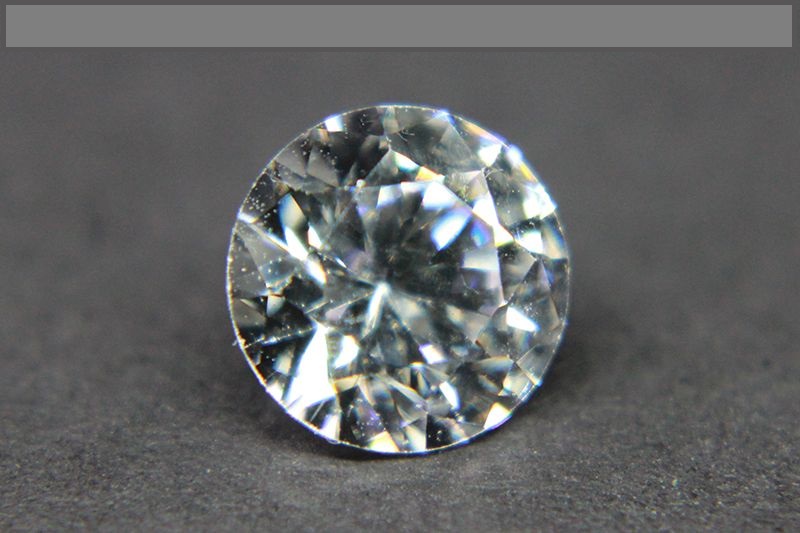
Cubic zirconia is similar to a diamond with its brilliance and crystal clarity, but it is a synthesized (man-made) crystalline material that is colourless, hard, and flawless. It looks so much like a diamond, it is an affordable alternative to diamonds. It can be made in different colours to simulate the different colours of a diamond.
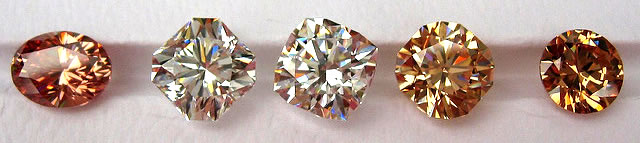
CZ scores a 8 on Mohs Scale
Cubic zirconia started being produced in 1976 because of its diamond-like qualities, low cost, and overall durability. Cubic zirconia crystals are made by melting powdered zirconium and zirconium dioxide together and heating them up to 4,982ºF. Cubic zirconia is a perfectly man-made, flawless stone that is free of inclusions.
Moissanite
Moissanite has a refractive index from 2.65 – 2.69, which is higher than a diamond.
Moissanite is a gemstone born from the stars. It was first discovered in 1893 by a French scientist named Henri Moissan, who later won the Nobel Prize in Chemistry. He discovered microscopic particles of the gem that would eventually bear his name in Arizona, in a crater created by a meteorite that fell to Earth. He initially thought that he had discovered diamonds, but later determined that the crystals were composed of silicon carbide.
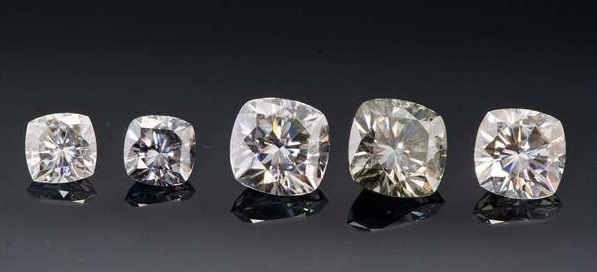
Natural moissanite is incredibly rare, so moissanite available today is laboratory-created. After many years of trial and error, the particles Moissan discovered were successfully synthesized to produce what is now one of the world’s most scintillating gemstones.
Moissanite is engineered to give the illusion of similarity to diamonds but is compositionally and visually quite different from a real diamond. The durability, brilliance, and colour of the two gems are quite distinct.
How Moissanite is Grown
The process involves growing silicon carbide (SiC) crystals under controlled conditions, replicating the natural formation process but on a much larger and more efficient scale. This results in high-quality, flawless gemstones that are both sustainable and beautiful. Here’s how moissanite is grown in a lab:
- Seed Crystal Preparation – The process begins with a small silicon carbide seed crystal, which serves as the foundation for the new moissanite crystal growth. These seeds are carefully selected to ensure consistency and high-quality formation.
- High-Temperature Growth Process – The seed crystal is placed in a controlled environment, typically in a high-pressure, high-temperature (HPHT) or chemical vapor deposition (CVD) growth chamber. The chamber simulates extreme conditions that allow silicon and carbon atoms to bond and form large SiC crystals.
- Layer-by-Layer Formation – Over weeks to months, the moissanite crystal grows layer by layer as silicon and carbon atoms attach to the seed structure. This controlled process ensures clarity and reduces impurities in the final gemstone.
- Cooling and Stabilization – Once the crystal reaches the desired size, it is carefully cooled at a controlled rate to avoid internal stress fractures. Proper cooling ensures the durability and structural integrity of the moissanite.
- Cutting and Polishing – After cooling, the raw moissanite crystal is cut into various gemstone shapes and polished to enhance its brilliance and fire. Expert gem cutters use precision techniques to maximize the stone’s light reflection and sparkle.
- Quality Control and Grading – Each moissanite gem is inspected for color, clarity, and optical properties. Only the highest-quality stones make it to the jewelry market.
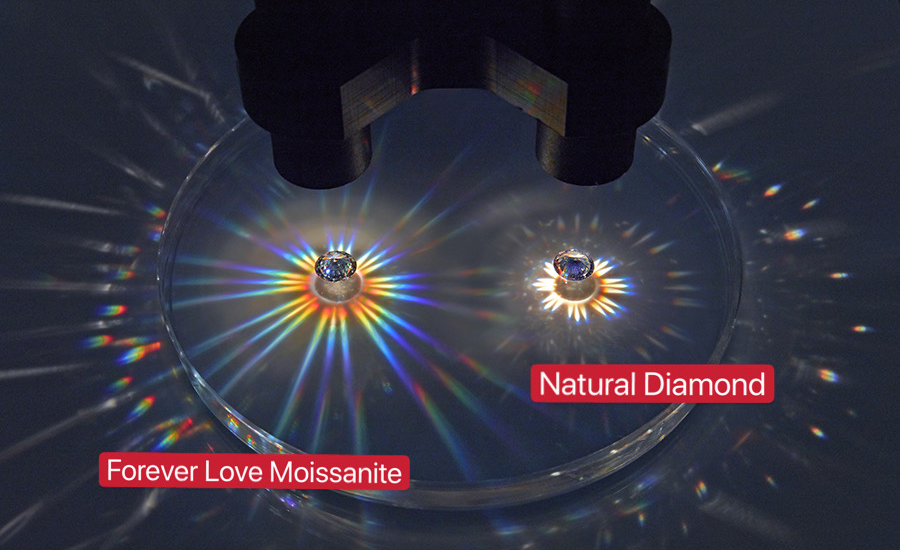
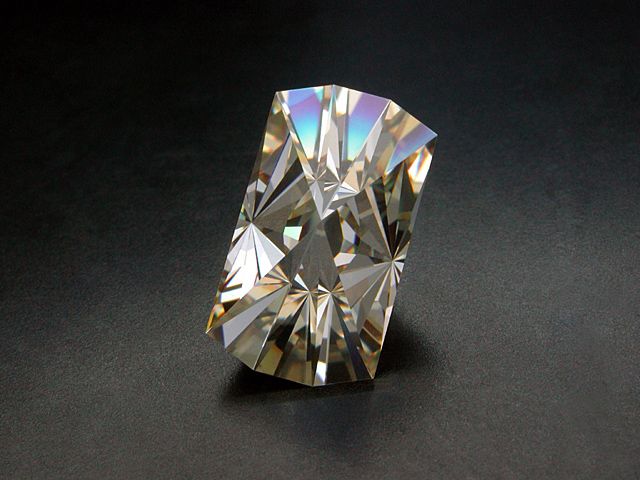
On the Mohs scale, moissanite scores a 9.25, a very good score that makes it one of the hardest substances on earth, and very suitable for everyday wear as an engagement ring. Moissanites exhibit a different kind of brilliance than diamonds do, as their faceting pattern is different. The fiery, rainbow flashes emitted by moissanite are beloved by some, but others feel that moissanite’s heightened brilliance can create a “disco-ball” effect, especially in sunlight. The bigger the moissanite, the more likely it is that the difference will be noticeable.
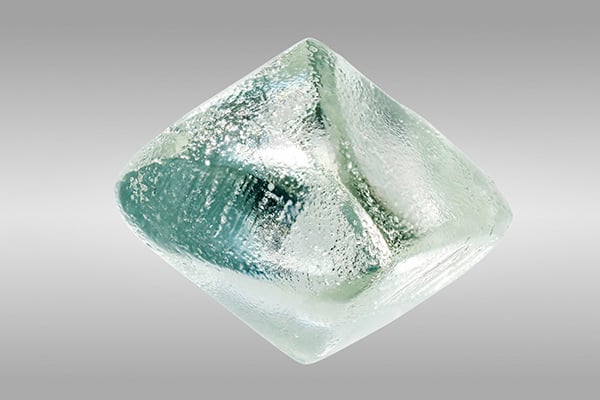
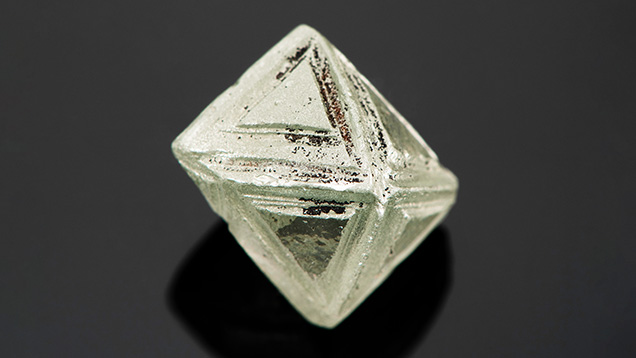
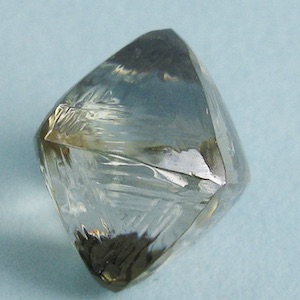
Moissanite vs. Diamond
Brilliance & Fire
One of the biggest differences between moissanite and diamonds is how they reflect light. Moissanite has a higher refractive index (2.65) compared to a diamond (2.42), meaning it has more brilliance and fire. This makes moissanite sparkle more vividly, sometimes even displaying rainbow-like flashes in certain lighting conditions.
Color & Clarity
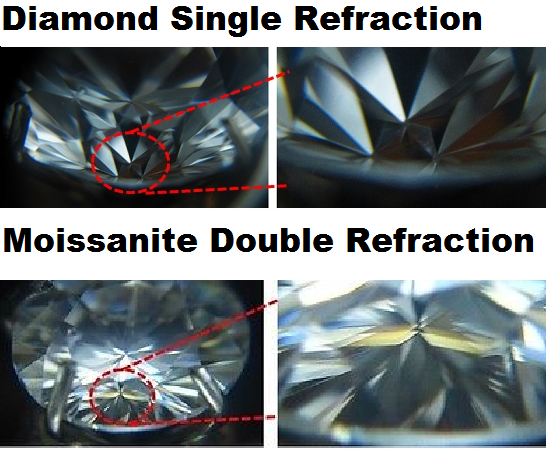
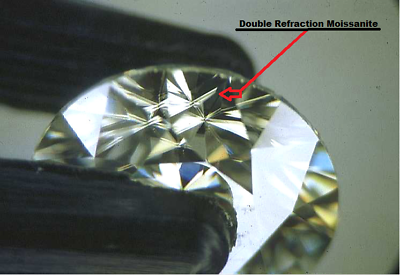
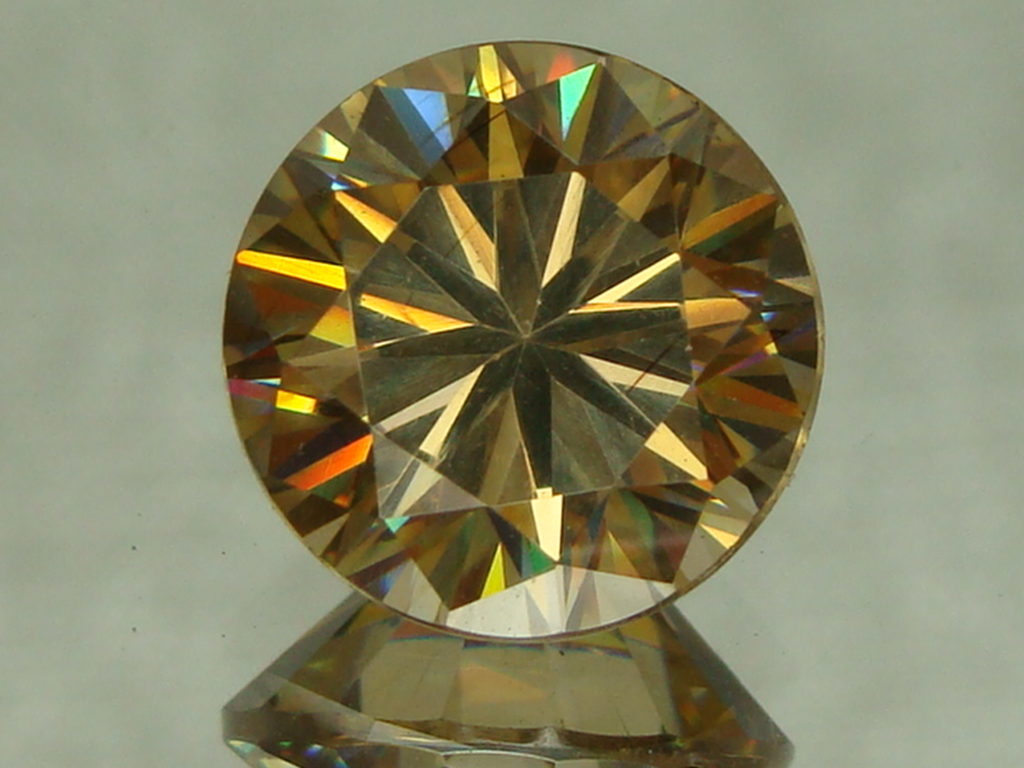
Moissanite is available in three main color grades: classic (slightly yellowish-green), near-colorless, and colorless. Modern high-quality moissanite, such as Charles & Colvard’s “Forever One,” is nearly indistinguishable from diamonds in terms of color and clarity.
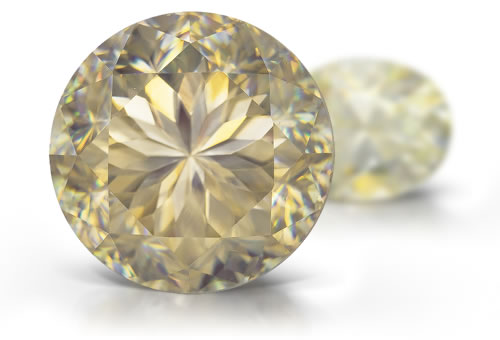
Other Diamond Simulants
- Gadolinium Gallium Garnet (GGG)
- Yttrium Aluminum Garnet (YAG)
- Strontium Titanate
- Synthetic Rutile
- Glass
Synthetic Diamonds (Lab-Grown)
Naturally, diamonds are made deep underground in a place of extreme pressure and temperatures.
The two methods of growing lab diamonds are:
- (CVD) Chemical Vapor Deposition
- (HPHT) High Pressure High Temperature
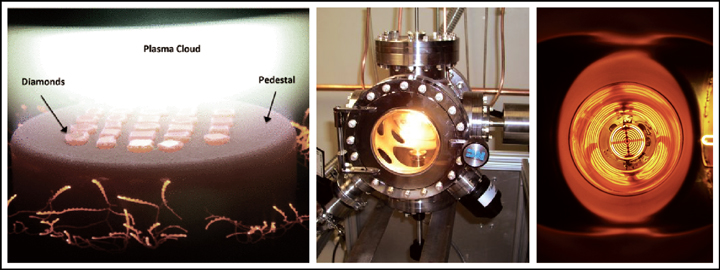
Synthetically, however, diamonds are grown out of a process known as nucleation. This is a process where a small bit of diamond known as a diamondoid, will promote the growth of a larger diamond. In the case of diamonds made at SLAC, the diamondoids are only about 10 carbon atoms in size. Scientists at SLAC make their diamonds using a process known as chemical vapour deposition. In essence, the scientists sprinkle some crushed up diamond onto a silicon wafer which is then heated up by plasma.
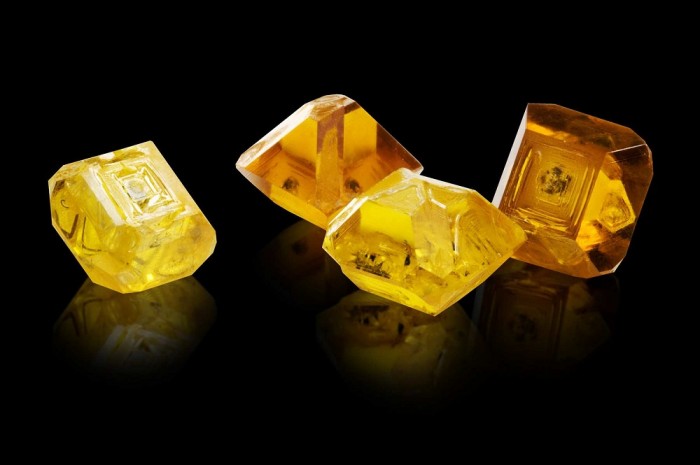
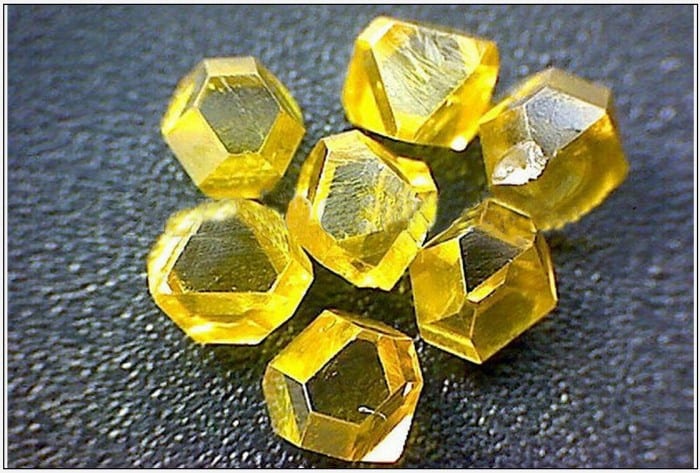
Plasma is the fourth state of matter and can be thought of like a really hot gas. So hot in fact, that atoms no longer exist, and instead, a soup of ions and electrons whizzing around each other exists. The plasma made of hydrogen and carbon; either dissolves the diamondoids or creates an environment that can encourage them to make larger diamonds, since both hydrogen and carbon are needed to make diamonds. At first, the diamondoids are too small to see under even the world’s best microscopes.
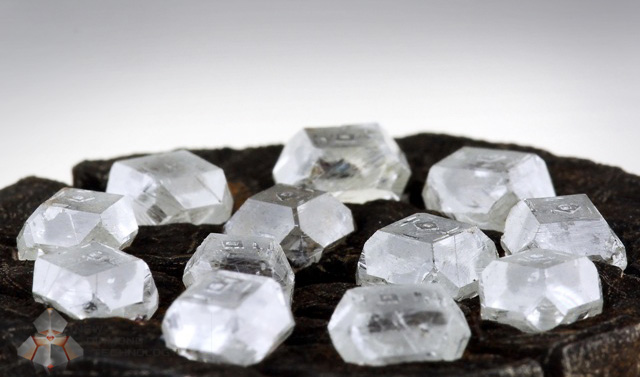
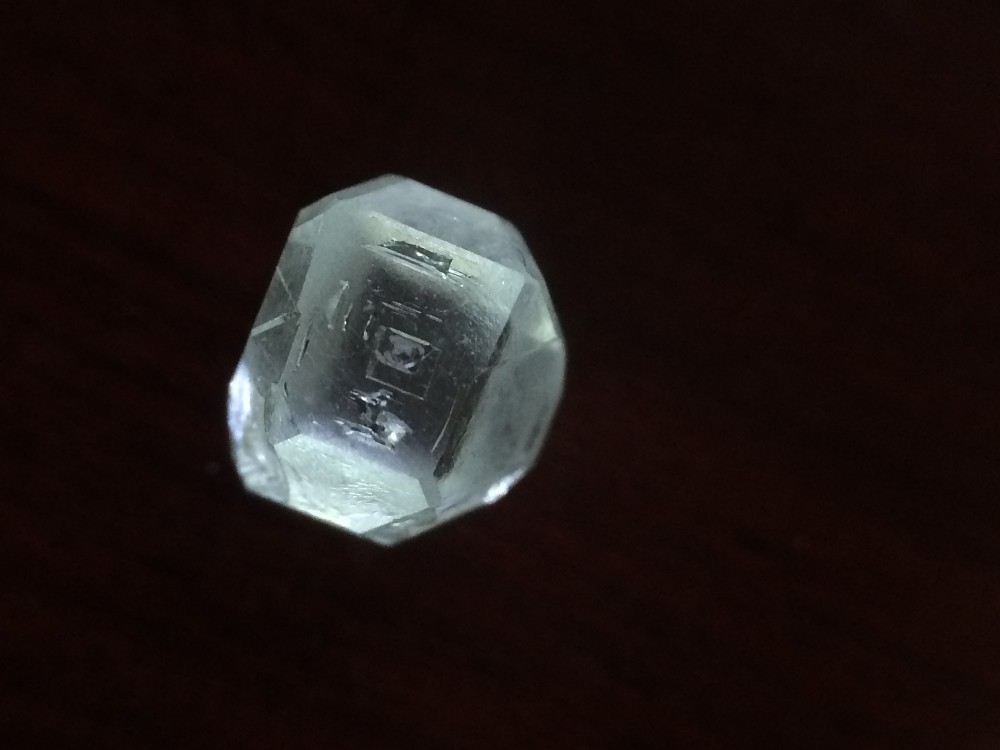
The best diamonds were formed with a diamondoid that was about 26 carbon atoms in size and seems to be the sweet spot for diamond formation. If however, this process goes wrong you can end up with just plain, boring, graphite rather than the glittering diamonds you were seeking.
The First Synthetic Diamond
15 February 1955
General Electric introduced the first reproducible, verifiable, witnessed synthetic diamond ever to be created. The synthetic diamond was a breakthrough in chemistry and revolutionized the use of diamonds in industry abrasives. Leading up to 1955, the idea of creating the naturally occurring hardest substance on earth in a lab seemed impossible. Chemists have tried, with mixed success, to create a man-made diamond. In 1941 G.E. announced it would dedicate funds and resources to pursue diamond synthesis. In 1951, a high-pressure diamond group was formed at the Schenectady Laboratories of G.E.
The team built a Diamond Press, an ultrahigh-pressure apparatus, designed to concentrate and sustain tremendous pressure in a small area just the conditions needed to create a diamond. In the press, a doughnut – size chamber was surrounded by conical pistons that produced pressures of 1.5 million pound per square inch and temperatures of 2760° C. Scientist placed metal and carbon inside the doughnut chamber, applied an electrical jolt that melted the metal-carbon mixture and initiated diamond crystallization. Extremely high pressures and temperatures within the chamber replicated the century’s long geological process that creates diamonds in nature. After 10-20 minutes of operation, scientists shut down the Diamond Press and peered inside the chamber to gaze at the first man-made diamond ever made.
“Man-made diamonds the climax to a 125-year effort to duplicate nature’s hardest and most glamorous substance was displayed here today” trumpeted G.E.’s press release dated 15 February 1955.
How to Test Lab-Grown Diamonds
Since lab-grown diamonds have the same chemical, physical, and optical properties as natural diamonds, specialized testing methods are needed to identify them.
Can You Tell the Difference with the Naked Eye?
- No—Lab-grown diamonds look identical to natural diamonds!
- They have the same brilliance, fire, and hardness (10 on the Mohs scale).
- Even expert jewelers can’t identify them without specialized tools.
- Key Differences Exist at the Atomic Level:
- Growth patterns
- Fluorescence
- Trace elements (HPHT diamonds may contain metallic inclusions)
Professional Testing Methods for Lab-Grown Diamonds
UV Fluorescence & Phosphorescence Tests
- Used to check how a diamond reacts to ultraviolet (UV) light.
- Some lab-grown diamonds glow differently than natural ones.
- CVD Diamonds may show blue phosphorescence (afterglow).
- HPHT Diamonds often display green, yellow, or orange fluorescence.
- Natural Diamonds usually show blue fluorescence.
- Tool Used: DiamondView by De Beers (uses deep UV light).
Magnetism Test (For HPHT Diamonds)
- Some HPHT diamonds contain iron, cobalt, or nickel used as catalysts.
- These metals make HPHT diamonds weakly magnetic.
- Simple Test: Use a strong magnet—if the diamond moves slightly, it could be HPHT.
- Not effective for CVD diamonds (which contain no metal).
Spectroscopy Analysis
- Spectroscopy checks how light interacts with the diamond’s atoms.
- Natural and lab-grown diamonds absorb light differently due to growth structure.
- Types of Spectroscopy Used:
- Infrared Spectroscopy (FTIR) – Detects impurities (natural diamonds often contain nitrogen).
- Photoluminescence (PL) Spectroscopy – Reveals growth patterns unique to lab-grown diamonds.
- UV-Vis Spectroscopy – Identifies trace elements.
- Not accessible for the average jeweler—requires advanced lab equipment.
Diamond Inscription (Laser Markings)
- Many lab-grown diamonds are laser-inscribed on the girdle with:
- “Lab-Grown” or “LGD” + certification number
- Can be checked under 10x magnification or a jeweler’s loupe
- Not all lab diamonds are inscribed—some may require further testing.
Diamond Tester (Thermal & Electrical Conductivity)
- Standard diamond testers check thermal conductivity (lab and natural diamonds both pass).
- Does NOT work for lab-grown diamonds—CVD and HPHT diamonds conduct heat the same as natural ones.
- Solution: Use an electrical conductivity tester
- Natural diamonds do NOT conduct electricity
- HPHT diamonds DO conduct electricity (due to boron impurities)
- Professional Tool: GIA iD100™ or PRESIDIUM Synthetic Diamond Screener.
Advanced Lab Tests (Diamond Grading Labs)
- For 100% accurate identification, a diamond must be sent to a professional grading lab like:
- GIA (Gemological Institute of America)
- IGI (International Gemological Institute)
- HRD Antwerp
- The lab report will state if the diamond is natural or lab-grown based on atomic structure and growth patterns.
Summary Table: How to Test Lab-Grown Diamonds
| Test Method | Effective for Lab Diamonds? | Best for |
|---|---|---|
| Visual Inspection | No | Anyone |
| UV Fluorescence | Yes | Professionals |
| Magnetism Test (HPHT) | Yes (for HPHT only) | Jewelers |
| Spectroscopy | Yes | Labs |
| Laser Inscription | Yes (if present) | Jewelers |
| Thermal Tester | No | Jewelers |
| Electrical Conductivity | Yes (HPHT conducts) | Professionals |
| Lab Certification (GIA/IGI) | 100% accurate | Buyers & Dealers |
Diamond Testing Equipment & Their Functions
Handheld Diamond Testers (Basic Level)
These are small, portable tools used by jewelers and dealers to quickly test diamonds.
- Diamond Thermal Conductivity Tester
- Function: Measures how fast heat moves through the diamond.
- Used for: Differentiating diamonds from moissanite, CZ, and glass.
- Limitations: Cannot tell the difference between natural and lab-grown diamonds.
- Popular Models:
- Presidium Diamond Mate-A
- Mizar Diamond Selector II
- Gemlogis VISTA
- Moissanite & Synthetic Diamond Tester
- Function: Detects whether a stone is moissanite or lab-grown based on electrical conductivity.
- Used for: Distinguishing moissanite from diamonds.
- Limitations: Cannot detect CVD lab diamonds, as they do not conduct electricity.
- Popular Models:
- Presidium Multi Tester III
- Gemlogis Taupe
Mid-Range Diamond Testing Devices (Professional Level)
- UV Fluorescence & Phosphorescence Testers
- Function: Uses ultraviolet (UV) light to check a diamond’s fluorescence and phosphorescence.
- Used for: Identifying CVD lab-grown diamonds, as they often show blue phosphorescence.
- Limitations: Not always conclusive for HPHT lab diamonds.
- Popular Models:
- DiamondView (by De Beers) – High-end UV imaging
- SSEF Diamond Spotter
- GIA iD100™ UV Light System
- Electrical Conductivity Testers
- Function: Checks for boron impurities, which cause electrical conductivity in HPHT lab-grown diamonds.
- Used for: Detecting HPHT lab diamonds.
- Limitations: Does not work for CVD diamonds.
- Popular Models:
- GIA iD100™ (Industry standard)
- Presidium Synthetic Diamond Screener II (SDS II)
Advanced Laboratory Diamond Testing Equipment (Expert Level)
- FTIR Spectroscopy (Fourier Transform Infrared)
- Function: Uses infrared light to detect nitrogen impurities in diamonds.
- Used for:
- Differentiating Type Ia (natural) and Type IIa (lab-grown) diamonds.
- Identifying treated diamonds.
- Limitations: Requires specialized training.
- Popular Models:
- Bruker ALPHA II FTIR Spectrometer
- Thermo Scientific Nicolet iS5 FTIR
- Photoluminescence (PL) Spectroscopy
- Function: Measures a diamond’s atomic defects and crystal growth patterns using laser excitation.
- Used for:
- Differentiating natural vs. lab-grown diamonds.
- Identifying HPHT & CVD diamonds.
- Detecting HPHT treatment in natural diamonds.
- Popular Models:
- Renishaw InVia Raman Microscope
- Horiba LabRAM HR Evolution
- UV-Vis-NIR Spectroscopy
- Function: Uses ultraviolet, visible, and near-infrared light absorption to identify diamond origin.
- Used for:
- Detecting color treatments in diamonds.
- Identifying HPHT and CVD diamonds.
- Popular Models:
- Agilent Cary 5000 UV-Vis-NIR Spectrophotometer
- PerkinElmer Lambda Series UV-Vis Spectrometer
Gemological Grading & Diamond Imaging Equipment
- Diamond Inscription & Magnification Devices
- Function: Checks for laser inscriptions on lab-grown diamonds.
- Used for:
- Identifying GIA/IGI inscriptions on synthetic diamonds.
- Examining diamond inclusions under magnification.
- Popular Models:
- Gemlogis Lupin 40X Jewelers Loupe
- GIA Gemolite Mark XI Microscope
- High-Precision Diamond Scanners
- Function: 3D scans a diamond’s cut, symmetry, and inclusions.
- Used for:
- Rough diamond planning & cutting.
- Precision grading of polished diamonds.
- Popular Models:
- Sarin DiaScan S+
- OGI Firetrace Scanner
Summary: Best Diamond Testing Equipment by Use Case
| Purpose | Best Equipment |
|---|---|
| Basic Diamond Testing | Presidium Diamond Mate-A, Mizar Diamond Selector II |
| Moissanite Detection | Presidium Multi Tester III, Gemlogis Taupe |
| UV Fluorescence Testing | De Beers DiamondView, GIA iD100™ |
| Electrical Conductivity (HPHT) | GIA iD100™, Presidium SDS II |
| FTIR Spectroscopy (Type I & II) | Bruker ALPHA II, Thermo Scientific Nicolet iS5 |
| Photoluminescence Spectroscopy | Renishaw InVia Raman, Horiba LabRAM HR Evolution |
| UV-Vis-NIR Spectroscopy | Agilent Cary 5000, PerkinElmer Lambda Series |
| Rough Diamond Imaging | Sarin DiaScan S+, OGI Firetrace Scanner |
| Laser Inscription Check | GIA Gemolite Mark XI, Gemlogis Lupin Loupe |
PLEASE PROCEED TO THE QUIZ