Back to: Rough Diamond Grading and Evaluation
Lesson 8
Inclusions
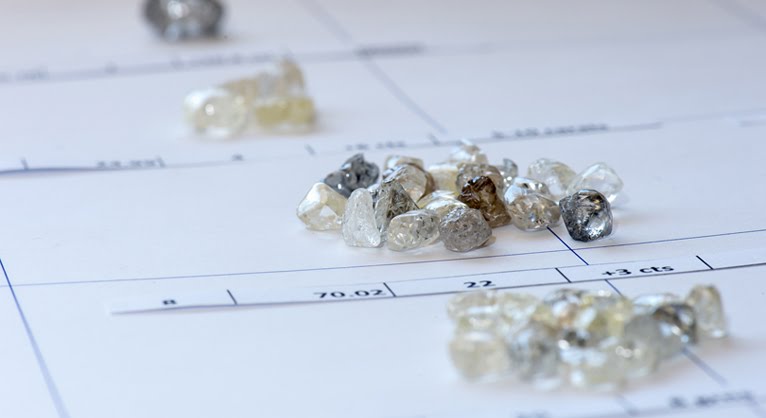
Inclusions are internal features within a diamond that formed during its growth in the Earth’s mantle. These imperfections can be solid minerals, gas bubbles, fractures, or growth irregularities. While some inclusions lower the diamond’s clarity grade and value, others provide insights into the diamond’s natural origin.
Diamond clarity is the quality of diamonds that relate to the existence and visual appearance of internal characteristics of a diamond called inclusions and surface defects called blemishes. They may look like tiny crystals, clouds or feathers. To view inclusions, jewellers and diamond dealers use a magnifying loupe.
This tool allows us to see a diamond at 10 x its actual size so that inclusions are easier to see. The position of the inclusions can affect the value of a diamond. There are very few flawless diamonds found in nature, thus these flawless diamonds are more valuable. All diamonds are graded based on their appearance – that is, the presence or absence of inclusions and blemishes under 10 x magnifications.
They are graded on a scale that ranges from Flawless to Imperfect.

Flawless: (F) Diamonds that have no inclusions and blemishes. To be graded as flawless, the diamond must appear completely clean to the gemmologist under both a loupe and a microscope at 10 x magnification.

Owned by Graff
Internally flawless: (IF) Diamonds that have no internal inclusions and only very, very minor blemishes that are apparent only under 10 x magnification.
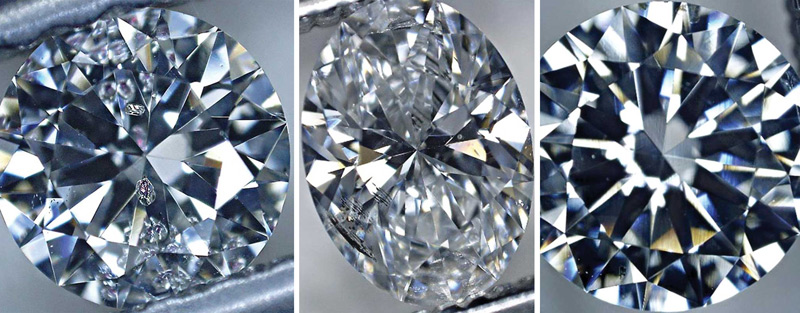
Very Very slightly Included: (VVS) Diamonds that are graded within one of two subcategories: VVS1 and VVS2. In both categories, the inclusions, which are present, are extremely hard to see, even for a trained gemologist. Often even under magnification, the inclusions are still only visible from the pavilion (upside-down position) and not in the face-up position. The most typical inclusions found in diamonds within these two clarity grades are a few tiny pinpoints, faint clouds, tiny feathers, or internal graining.
Very Slightly Included: (VS) These diamonds are also graded within one of two subcategories: VS1 and VS2. They have minor inclusions which are minute and impossible to detect with the naked eye, but which are apparent to a gemmologist under 10 x magnifications. Inclusions, which are typical in these clarity grades, include small-included crystals, feathers, distinct clouds, and groupings of pinpoints.
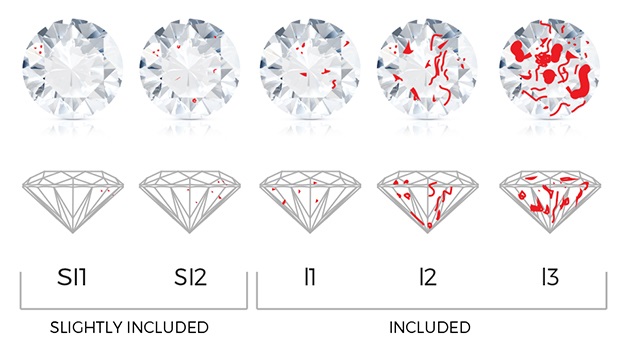
Slightly Included: (SI) these diamonds fall within one of two subcategories: SI1 and SI2. Within both of these categories, inclusions are often centrally located and easily detectable under 10 x magnification. In some cases, an inclusion may even be visible to the naked eye when the diamond is held a couple of inches away from the viewer’s eye, though no inclusions will be visible when the diamond is mounted or held at a normal wearing distance (12” to 16”) from the eye. Typical inclusions in this clarity graded are included crystals, clouds and feathers.
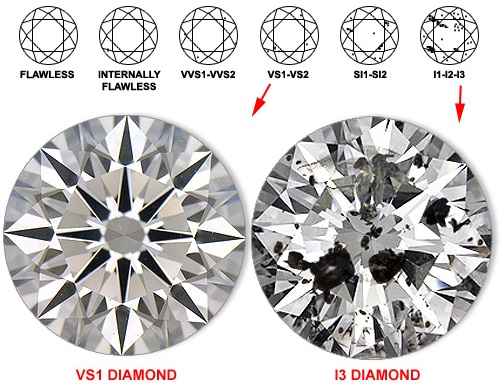
Imperfect: (I) these diamonds are actually subdivided into three categories: I1, I2 and I3 though it is unlikely that you will ever see an I3 being sold s jewellery (because of the severity of their inclusions, they are usually used as industrial abrasives instead). However, it is not uncommon to find many attractive I1 and I2 diamonds being sold today. These grades contain inclusions that are very obvious under 10 x magnification; these inclusions may even be visible to the naked eye as well. Typical characteristics of these grades include large included crystals and feathers. Because of their lower clarity, I1 and I2 diamonds can offer excellent cost savings for customers who are working with a smaller budget but still desire a good size diamond.
NOTE: WE HIGHLY RECOMMEND NOT PURCHASING ANY ROUGH WITH THE CLARITY GRADE OF I3 AND I2
Loupe
Jewelers typically use a monocular, handheld loupe in order to magnify gemstones and other jewelry that they wish to inspect. A 10× magnification is good to use for inspecting jewelry and hallmarks and is the Gemological Institute of America’s standard for grading diamond clarity. Stones will sometimes be inspected at higher magnifications than 10×, although the depth of field, which is the area in focus, becomes too small to be instructive. The accepted standard for grading diamonds is therefore that inclusions and blemishes visible at 10× impact the clarity grade.

Of all the special tools used in the diamond and jewellery industry, this might be the most recognizable. A jeweller’s loupe, pronounced loop, is basically a fancy magnifying glass. Loupes, sometimes referred to as hand lenses, are easy to use and have become an invaluable tool for jewellers as well as diamond buyers alike.
What is a loupe?
A loupe is a magnification tool used to inspect diamonds during the certification process, by a jeweller inspecting a stone or by a diamond buyer. The loupe has either one or three lenses and magnifies an object multiple times for easier viewing of tiny details. Loupes may be hand-held, attached to a visor or mounted on a stand. Professionals involved in diamond grading and certification generally use a three-lens loupe with 10 x magnification, meaning the diamond appears ten times as large as it really is.
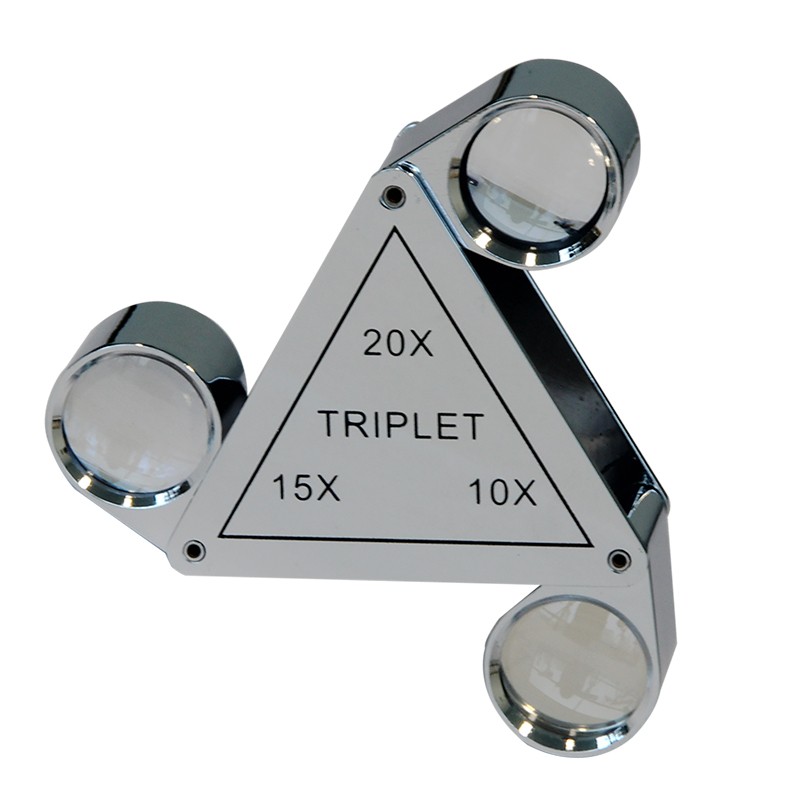
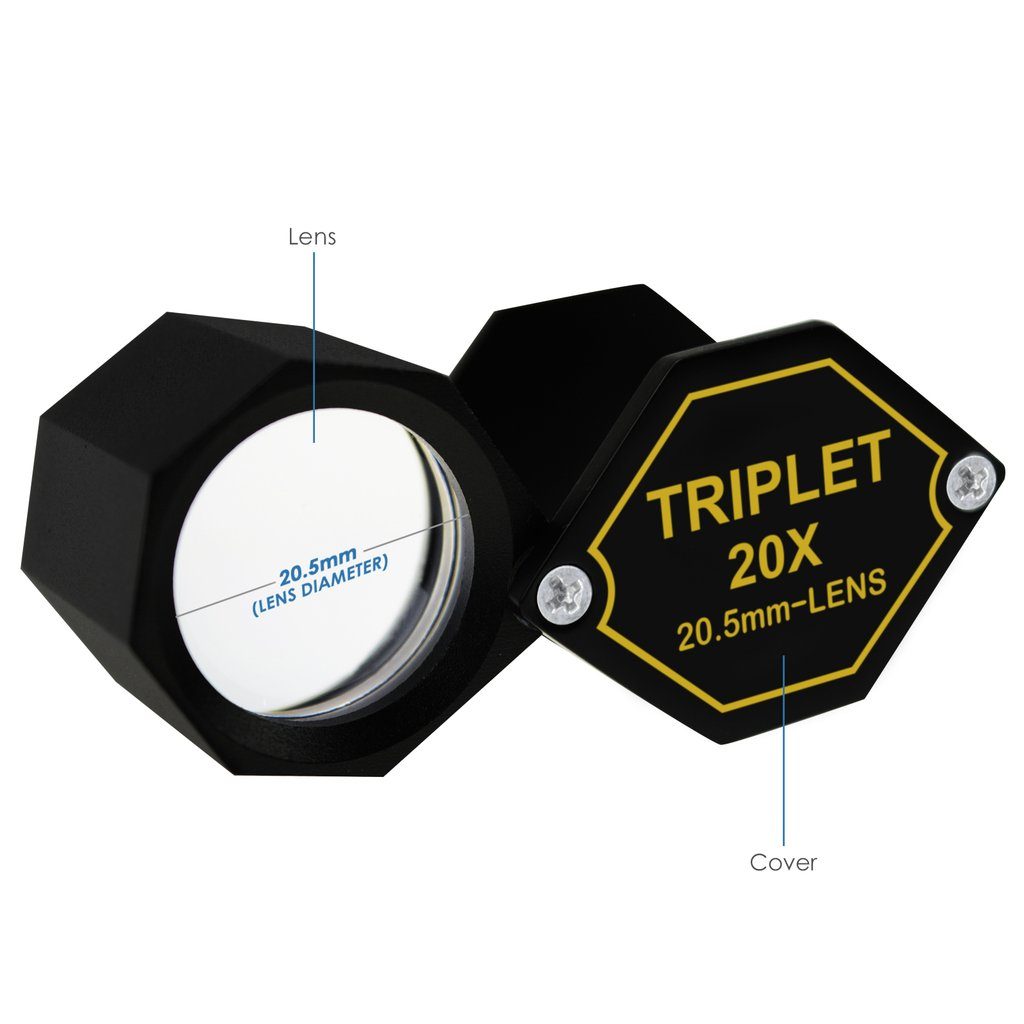

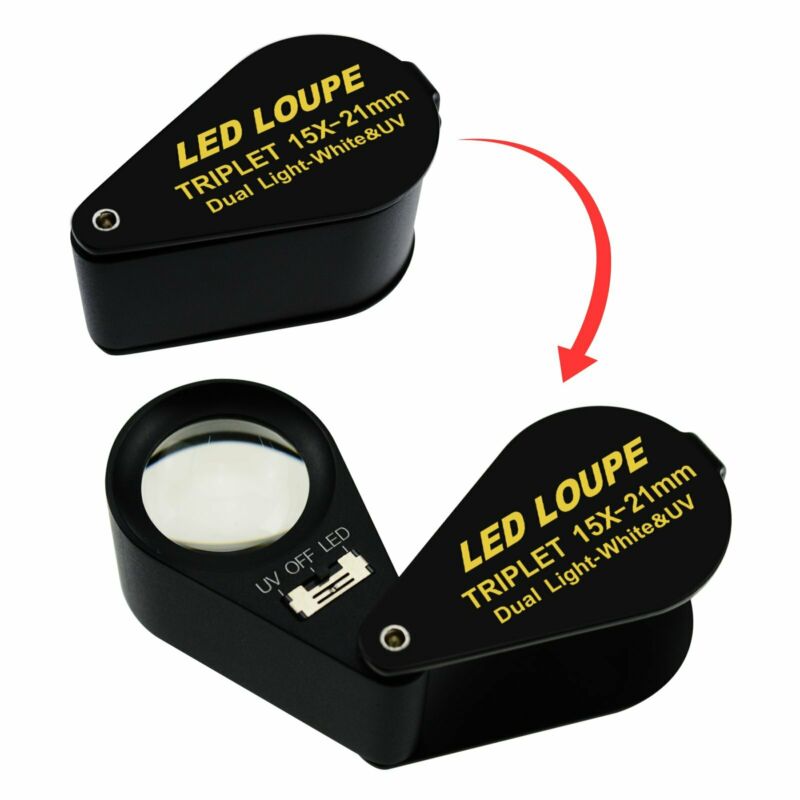
A loupe will show you what the naked eye cannot.
At 10 times magnification, a loupe is perfect to assess diamond inclusions which are internal as well as diamond blemishes which are external.
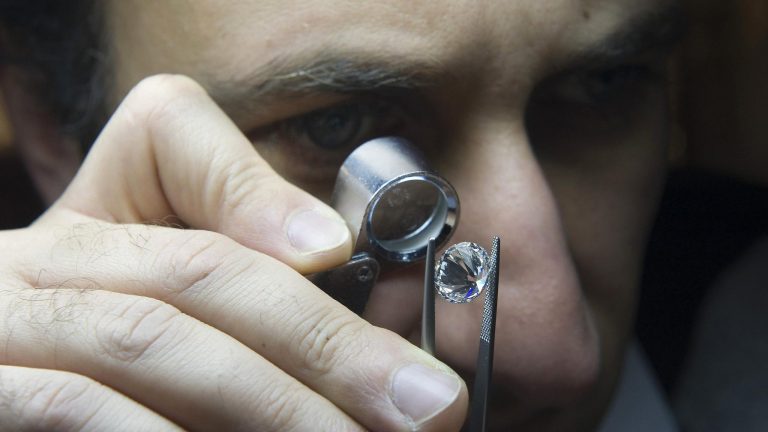
For a more detailed evaluation, certification companies use a diamond scope. As you can imagine, the scope is used to examine many things. For example diamond cut, diamond symmetry as it pertains to diamond facets, diamond colour, evaluating the overall diamond shape, diamond polish, the overall anatomy of a diamond including the proportions as it affects diamond carat weight in addition to inclusions and blemishes. Aside from evaluating gemstones and jewellery, loupes are used in many fields and industries, such as watchmaking, photography, printing, geology and dentistry.
Measurements of a loupe
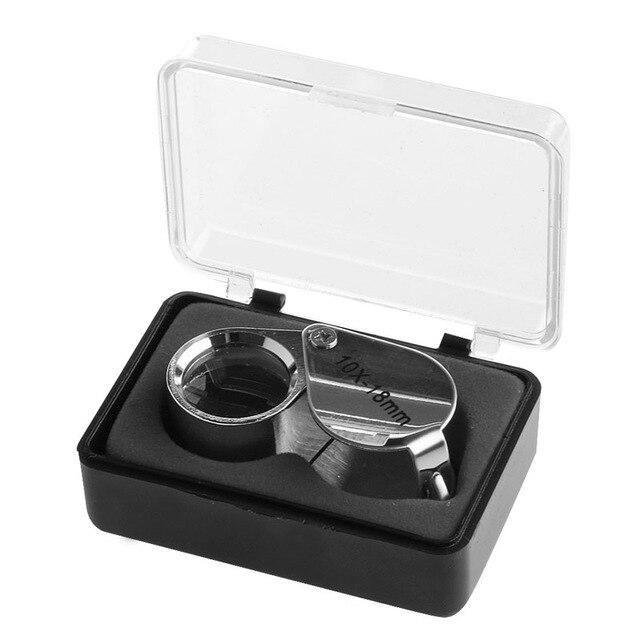
The different parts of a loupe that combine to magnify a diamond for evaluation and certification include the number of lenses, size of the lenses, magnification strength, focal range and lens material. The most popular loupe used for diamond inspection is a triple-lens loupe with 10 x magnification. A loupe with 18 mm lenses is an adequate size for evaluating diamonds.
How to Correctly Use a Loupe
The 1st Step, unfold the loupe and slip your index finger—either one will do—into the opposite opening from the glass.
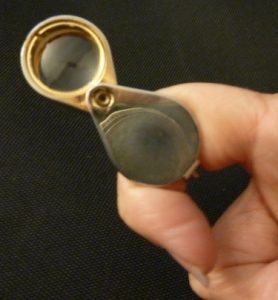
The 2nd Step, hold the loupe up to your face so the first knuckle on your thumb is firmly pressed against your cheek and the glass is positioned directly over your eye.

holding polished goods with a tweezer

holding rough goods with your fingers
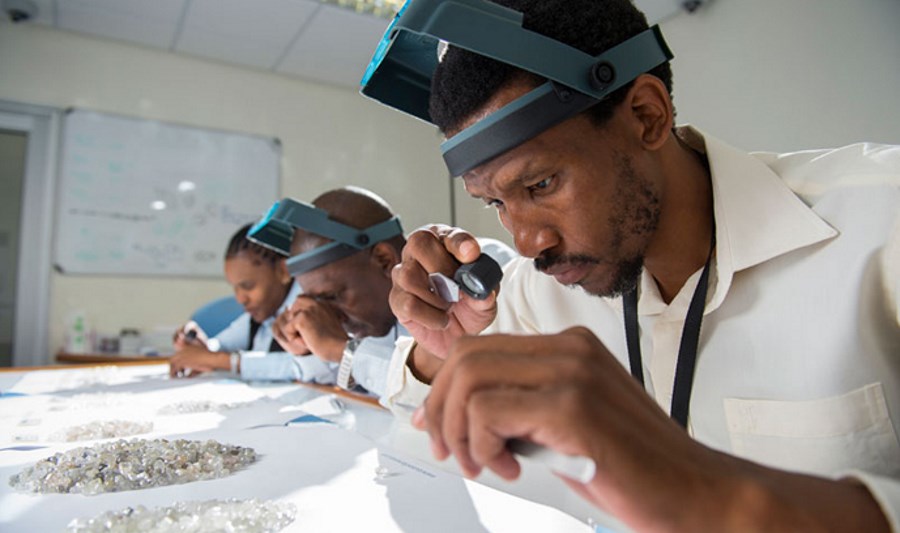
The 3rd Step, with your other hand, move the diamond to within 1 to ½ inches of the lens. Keep the hand holding the loupe steady. Don’t move it. Then lean your elbow on a table to steady your loupe holding hand.
Move the diamond in or out until it comes into focus, again, usually within 1 to ½ inch of the lens. Move the rough diamond around. Look at it from different angles. Take your time.
Can Inclusions Be Removed?
- Laser Drilling: Removes dark inclusions by vaporizing them with a laser beam.
- Fracture Filling: Fills cracks with a glass-like substance to improve clarity.
- However, these treatments reduce the diamond’s value compared to untreated stones.
Treatments
“Better a diamond with a flaw than a pebble without” Confucius. In some cases, cutters may choose to use certain treatments in order to improve the clarity grade of a diamond. Some of these treatments are common and accepted practices; others are less permanent and less accepted
Laser Drill Holes
Laser drill holes are one of the few man-made inclusions that can occur inside a diamond. Why on earth would anyone want to drill holes into a perfectly good diamond? It may seem counter-intuitive, but drilling this type of hole into a diamond can actually raise its clarity grade. In some diamonds, the clarity grade may be determined mainly by the presence of just one or two dark included crystals in a diamond that is otherwise relatively free of inclusions. In certain circumstances, the diamond cutter will decide to use a procedure to remove the dark inclusions and, hopefully, increase the clarity of the diamond. The process involves using a laser to drill tiny holes (thinner than a hair) in the stone, all the way from its surface towards the inclusion inside. This channel is then used to remove the inclusion by either melting it with heat or dissolving it with acid. The structural stability of the diamond is not compromised in any way by this hole, and the process is permanent.
Fracture Filling
Fracture filling is a process that is performed on certain diamonds, which have white feathers that reach to the surface of the stone. To reduce the appearance of the feather, thereby making the clarity seem higher, some cutters will force a liquid into the diamond through this fracture. The liquid then hardens to a clear solid, filling the fracture and reducing its appearance under magnification. However, this treatment is not permanent; under sufficiently high heat, the liquid may melt and leak out of the diamond, leaving the diamond in its original state. Because this particular type of treatment is not permanent, and because many in the diamond trade regard it as a somewhat deceptive practice, most labs (including GIA and AGS refuse to grade diamonds that have been fracture-filled). Experts using sophisticated gemological equipment do grading in labs. When a gemologist grades a diamond, he or she also creates a “plot” of a stone, essentially a blueprint of every clarity characteristic that appears in the diamond.
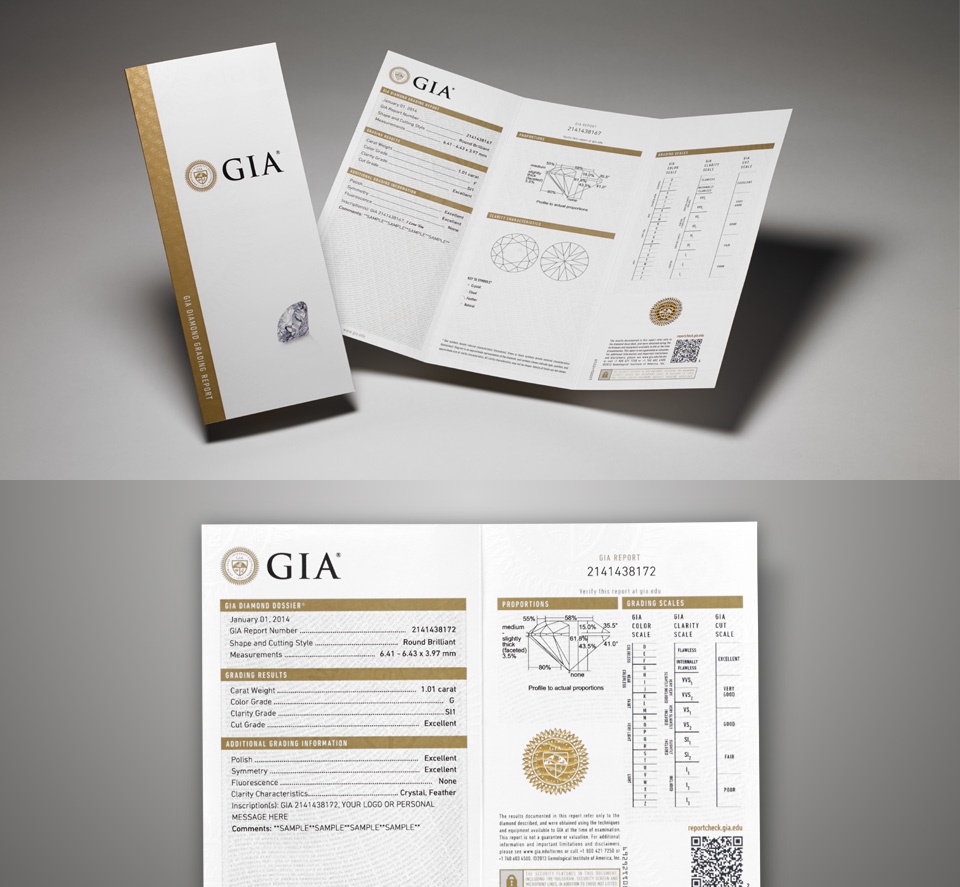
This plot is found on the right-hand side of the diamond grading certificate.
An exception is the case of some smaller weight diamonds, which are certified with GIA “dossiers” rather than with full-size grading reports; dossiers describe the main characteristics of the diamond but do not plot them out. Every diamond that is accompanied by a dossier also has the certificate number microscopically laser-inscribed on its girdle as proof of its identity. While the presence of these clarity characteristics do lower the clarity grade, and therefore the value, of a diamond they can also be viewed as proof of a diamond’s identity. Since no two diamonds are exactly the same, comparing the uniqueness of your diamonds clarity characteristics with the plot provided on the diamond certificate offers assurance that the diamond you pay for is the same diamond you receive.
Plotting
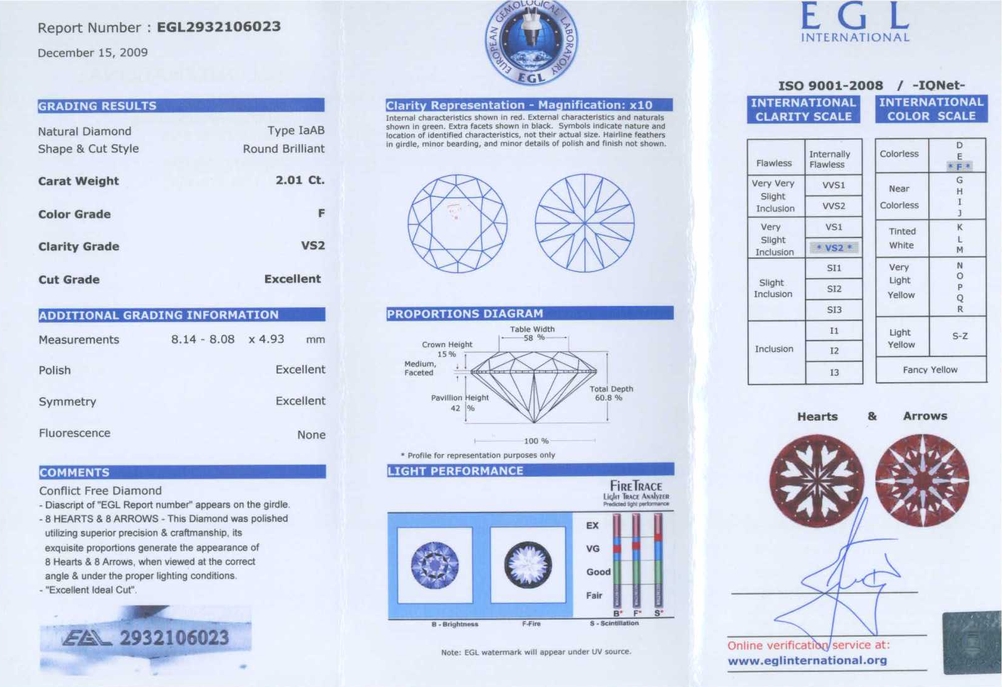
A plotting diagram is a map of a diamond’s clarity characteristics. These are the blemishes that reside on a diamond’s surface and the inclusions which are internal characteristics. It documents the diamond’s present condition, supports the diamond’s clarity grade, and because no two diamonds will have the same diagram, it serves as a means of identification.
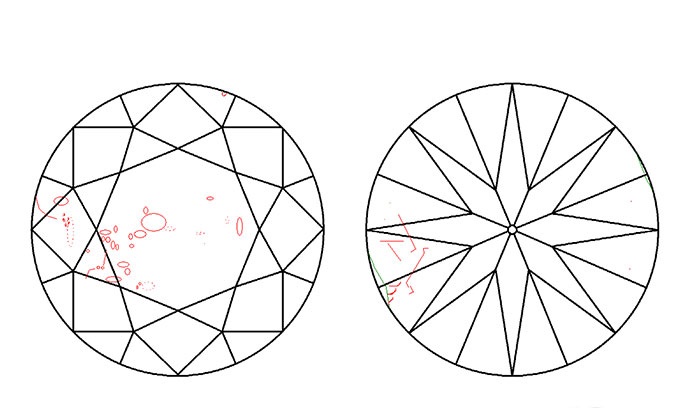
The diagram itself will match or closely resemble the shape of your stone and its facet arrangement, which allows you to understand where each identifying feature is located on the diamond. Also, the plotting diagram will feature two views of your diamond: the crown view (from the top) and pavilion view (from the bottom). The crown and pavilion orientations will show how the face-up view corresponds to the face-down view.
When plotting the diamond, each category of clarity characteristics is assigned a colour. The colours and markings will help you identify each type of characteristic:
- Red: indicates most inclusions
- Red and green: when used together indicate cavities, indented naturals, knots, etch channels and laser drill-holes
- Green: indicates naturals
- Black: indicates extra facets
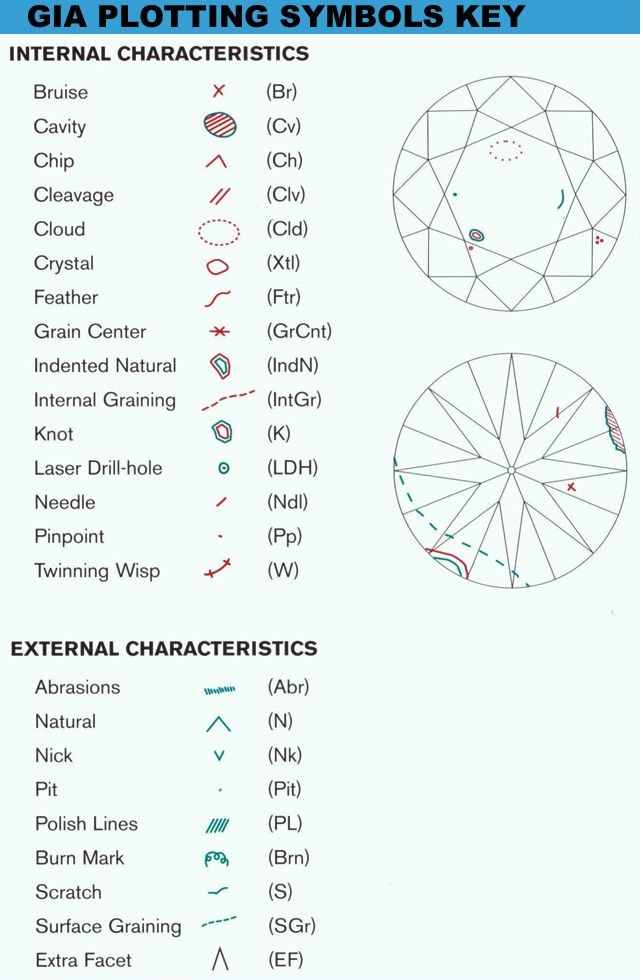
Here is a list of the characteristics that may appear on a plotting diagram, along with their corresponding symbols:
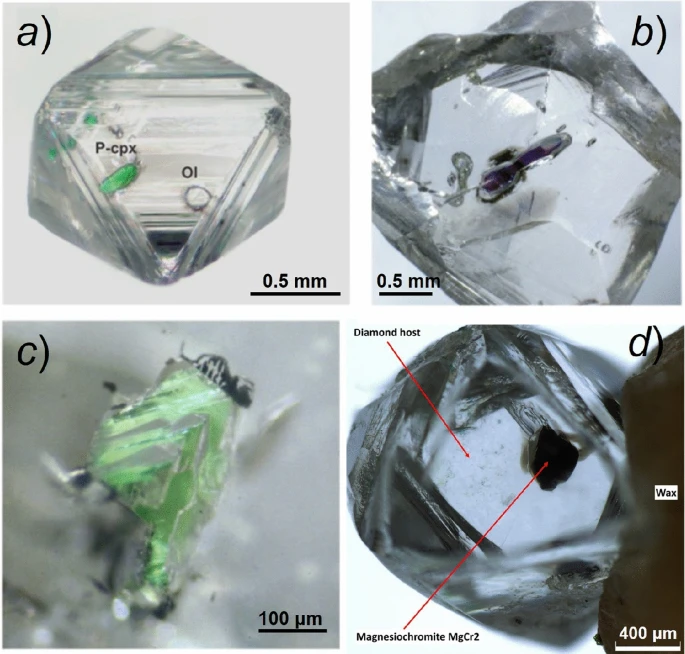
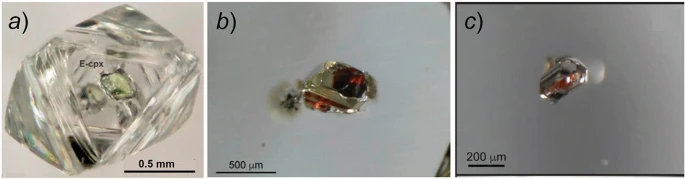
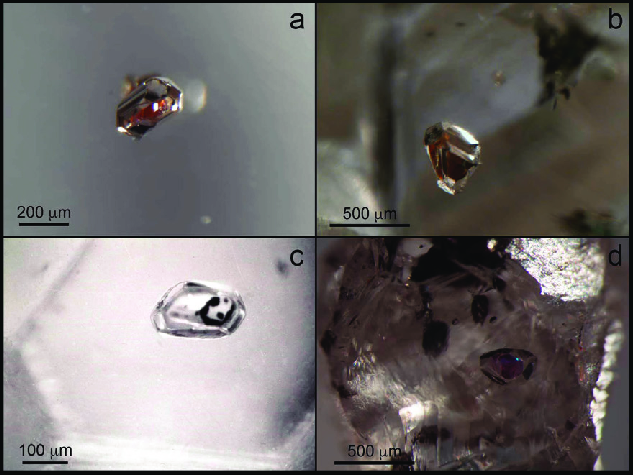
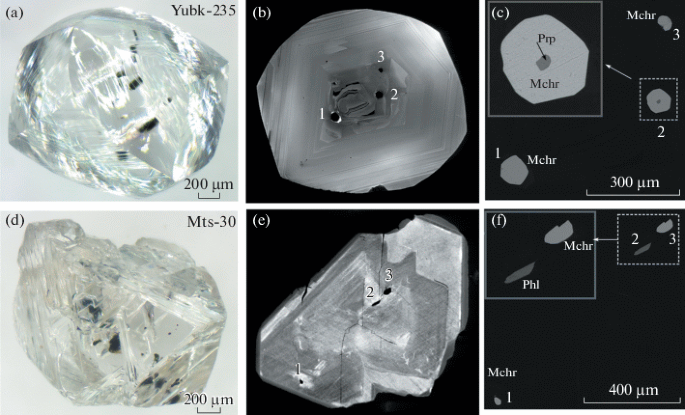
Types of Inclusions in Rough Diamonds
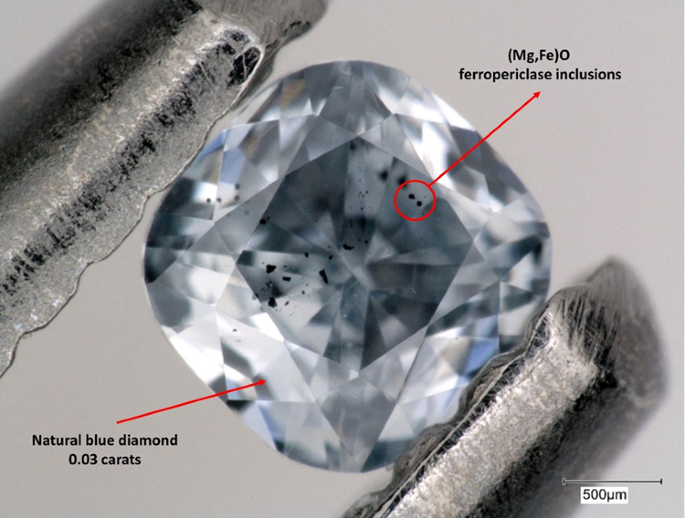
1. Mineral Inclusions (Crystals & Needles)
- Description: Tiny crystals of other minerals trapped inside the diamond during formation.
- Common Minerals Found:
- Garnet (reddish-brown)
- Peridot (Olivine) (greenish)
- Graphite (black or gray)
- Chromite & Ilmenite (metallic black)
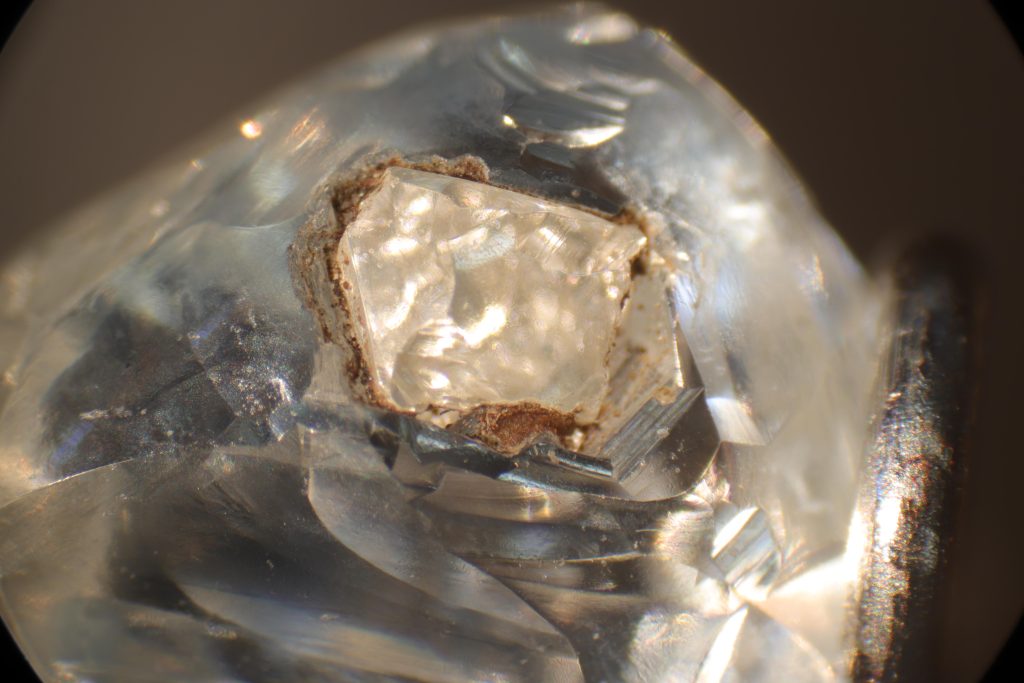
- Diamond Crystals (sometimes diamonds contain smaller diamonds inside!)
- Impact: Black mineral inclusions like graphite are more noticeable and lower the clarity grade, while transparent minerals have less impact.
Feathers (Internal Cracks or Fractures)
- Description: Small internal fractures that look like white, wispy lines.
- Cause: Stress during diamond formation, transportation to the surface, or mining.
- Impact: Large feathers may weaken the diamond’s structure and affect durability.
Clouds
- Description: A cluster of tiny pinpoints or microscopic crystals, appearing as a hazy or milky area inside the diamond.
- Impact: Can reduce transparency and light performance, making the diamond appear dull or foggy.
Pinpoints
- Description: Tiny white or black specks within the diamond, only visible under magnification.
- Impact: Minimal effect on clarity unless they form a noticeable cluster (cloud).
Twinning Wisps
- Description: Wavy, ribbon-like patterns caused by irregular growth during diamond formation.
- Impact: If extensive, they can affect transparency and brilliance.
Knots
- Description: A diamond crystal that reaches the surface of the rough stone.
- Impact: Can make polishing difficult and create weak points in the final cut stone.
Internal Graining
- Description: Lines or planes inside the diamond, caused by irregular growth patterns.
- Impact: Can create a hazy or distorted appearance.
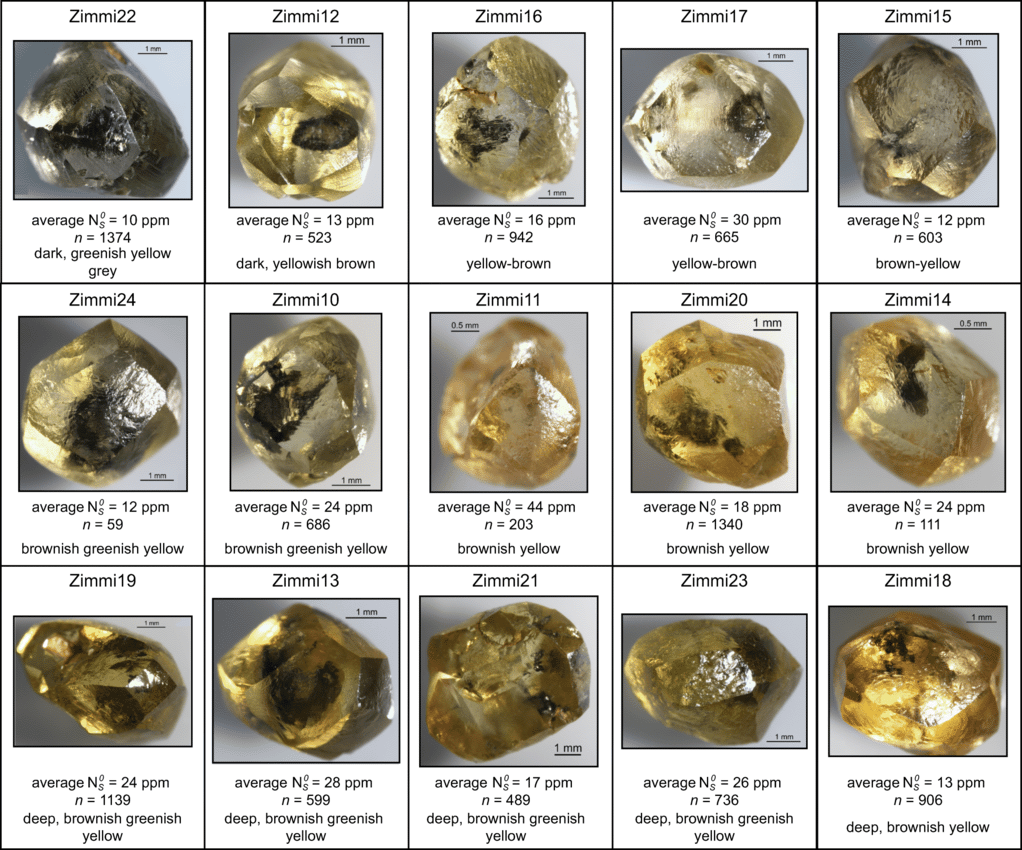
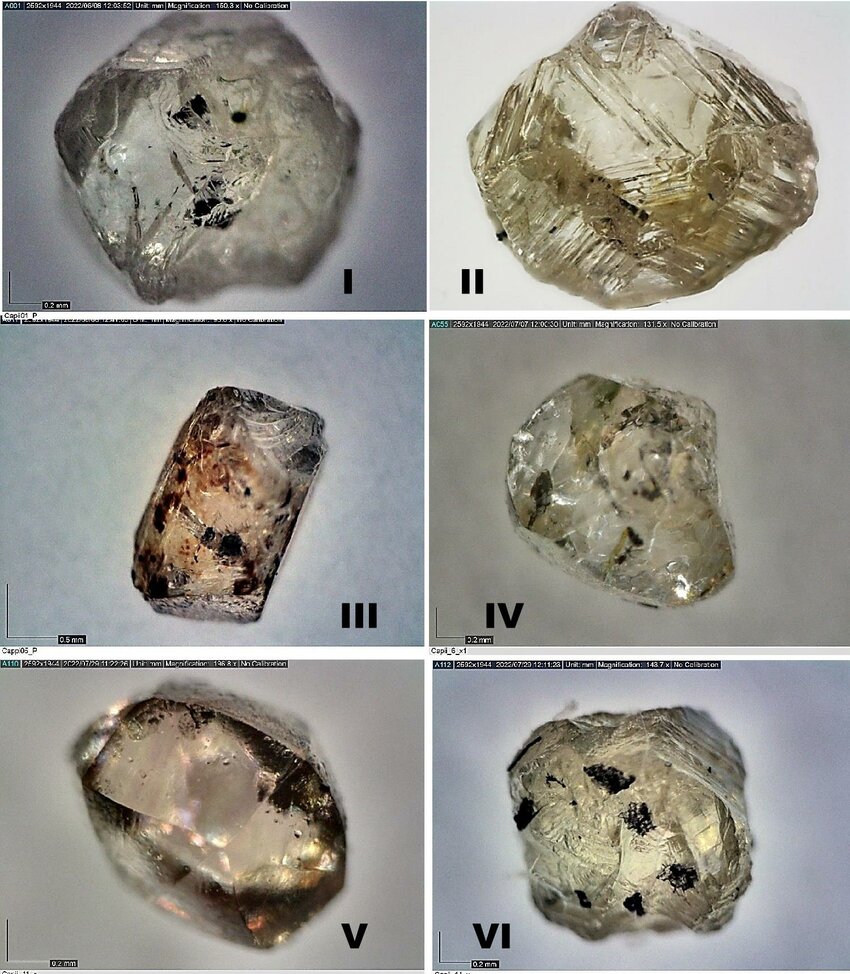
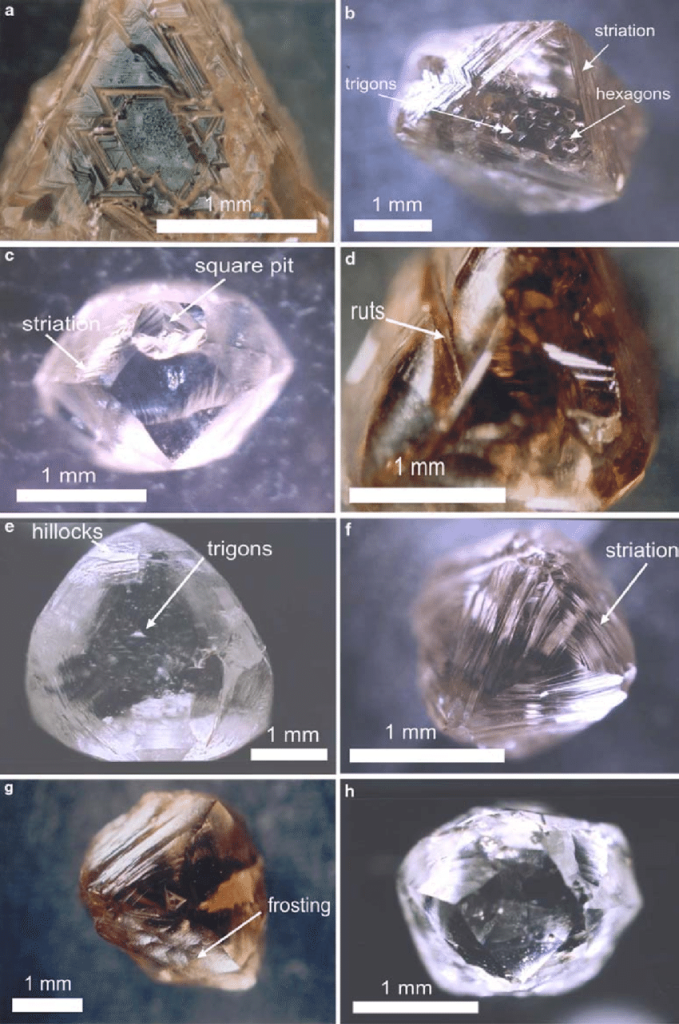
Inclusions in Rough Diamonds
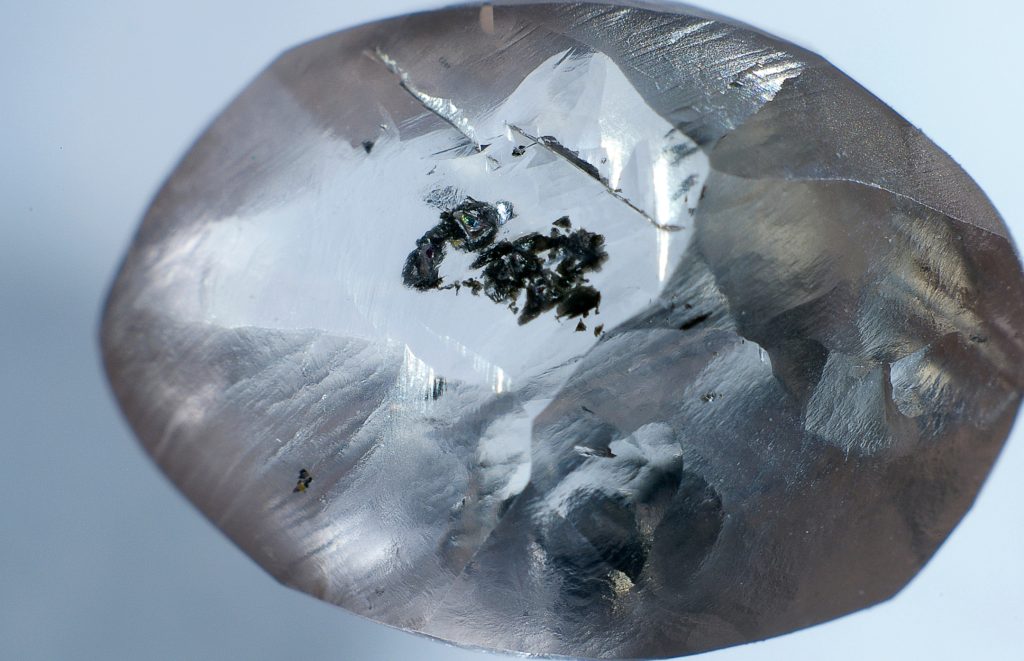
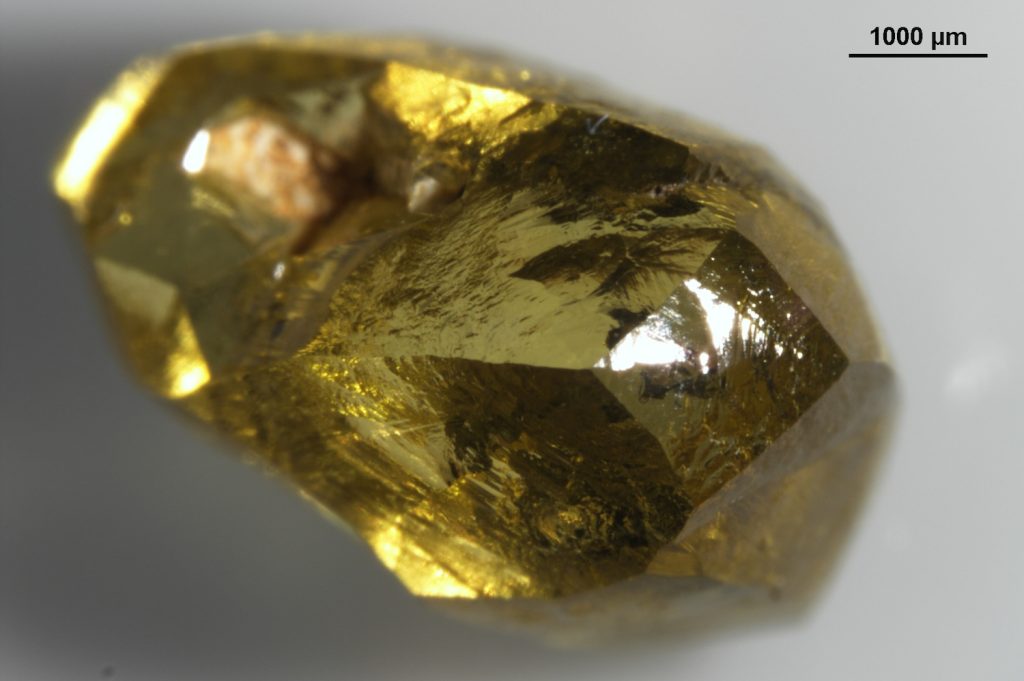
(Image credit: Karen Smit/GIA)
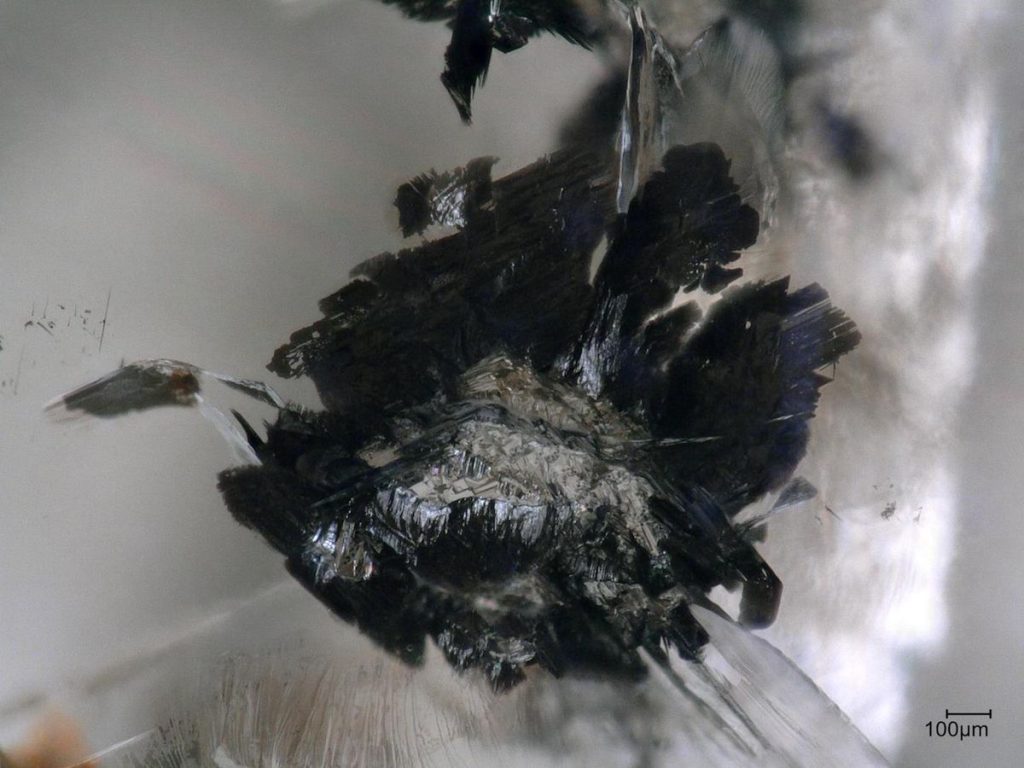
(Image credit: Karen Smit/GIA)
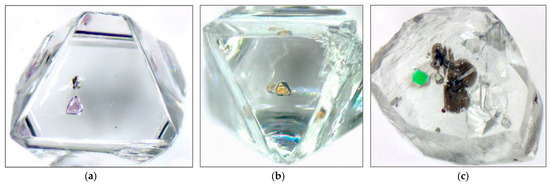
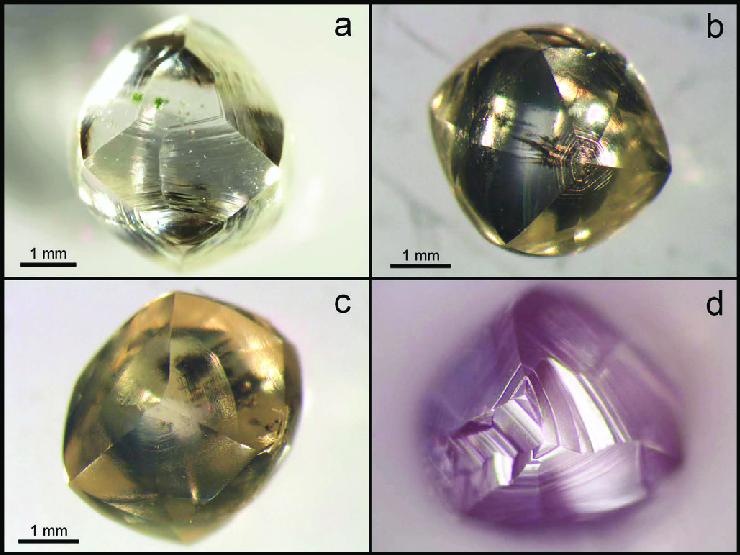
Images in (a,b,c) by Karen Smit.
Image in (d) by Yana Fedortchouk.
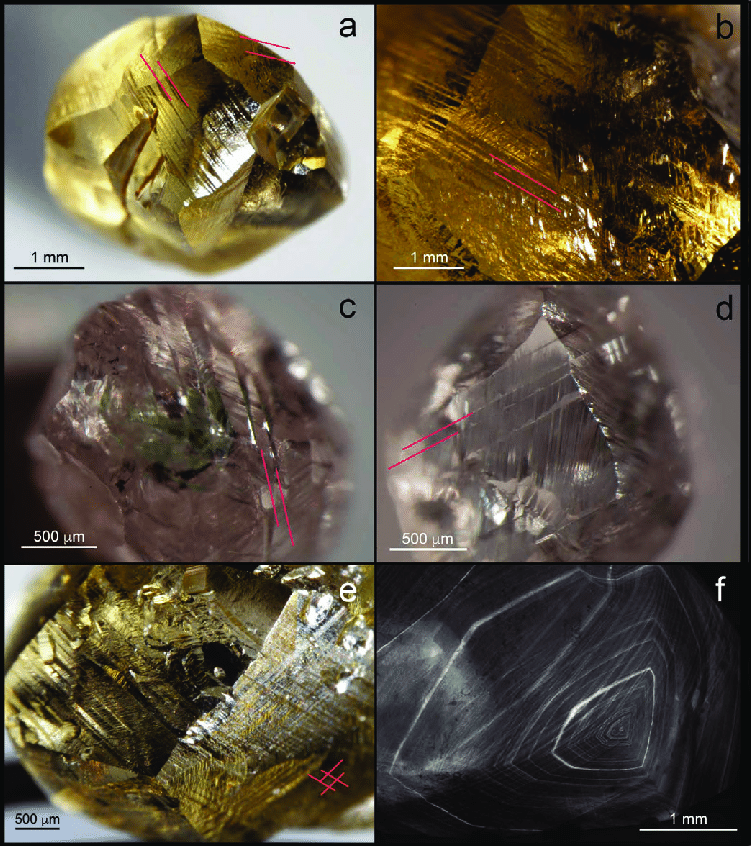
Images in (a,b,e,f) by Karen Smit.
Images in (c,d) by Nicole Meyer (University of Alberta).
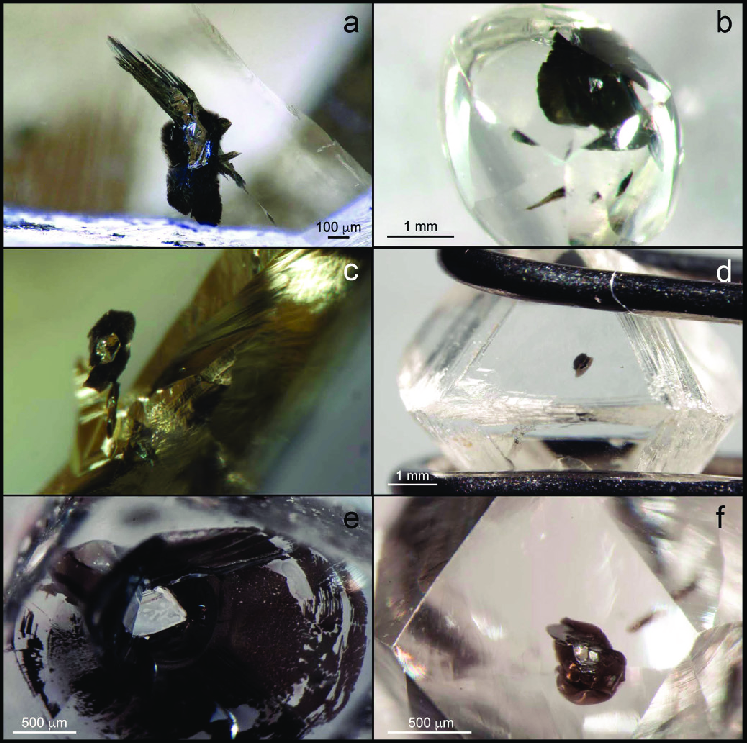
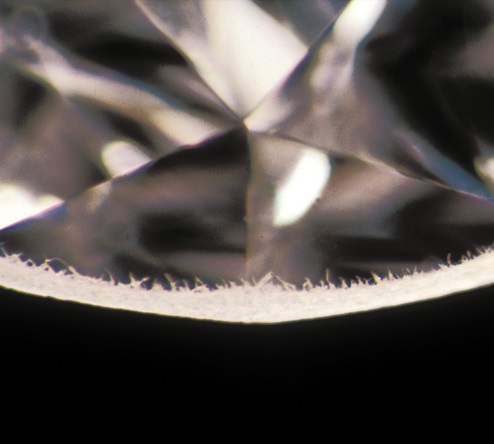
Very small feathers that extend from the girdle surface into the stone; can result from the cutting process.
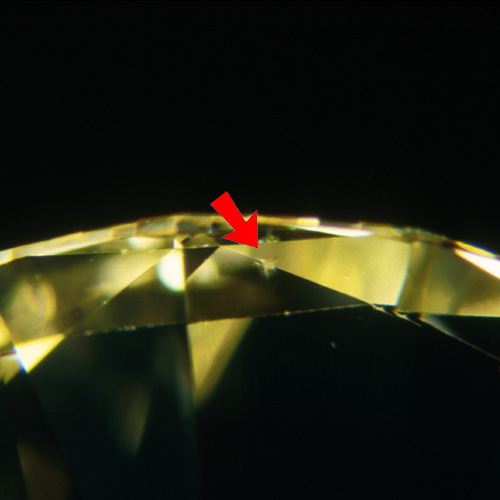
A tiny area of impact accompanied by very small, root-link feathers; typically occurs at a facet junction.
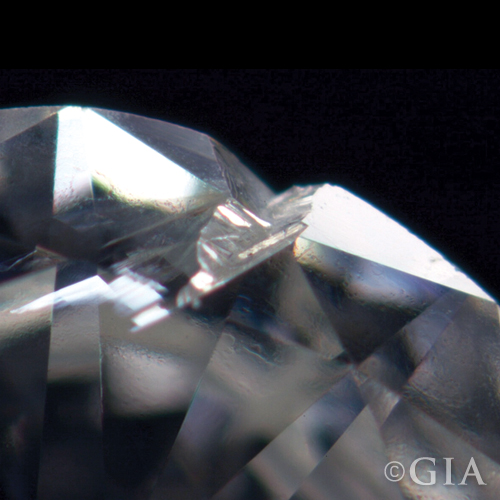
An angular opening created when part of a feather breaks away or when a surface-reaching crystal drops out or is forced out during polishing.
Courtesy of GIA
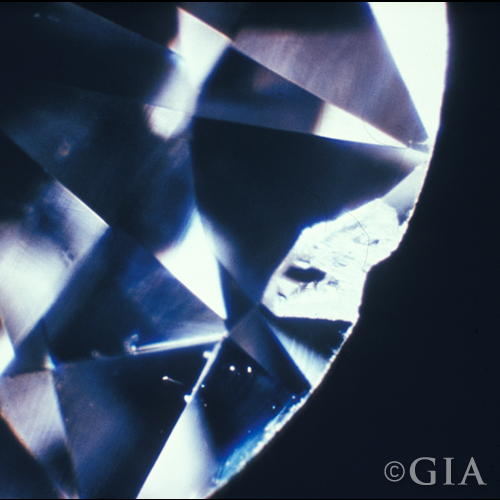
A shallow opening caused by damage to the stone’s surface that typically occurs at a girdle edge, facet junction, or culet.
Courtesy of GIA
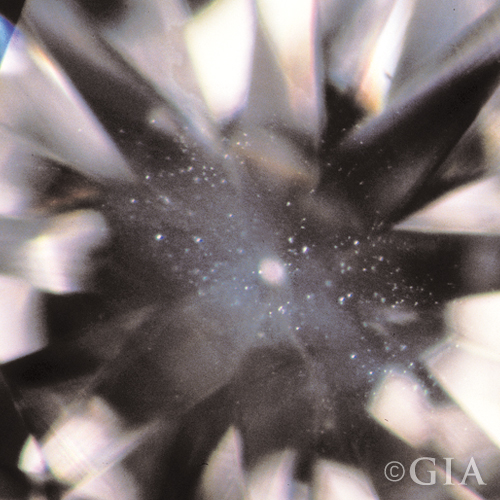
Many tightly grouped pinpoints that might be too small to distinguish individually but together have a hazy appearance.
Courtesy of GIA
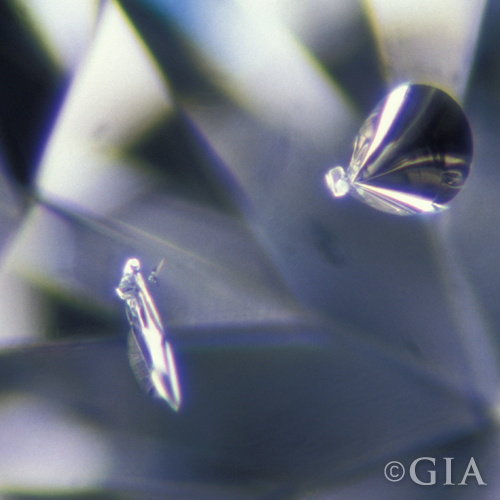
A mineral crystal contained in a diamond.
Courtesy of GIA
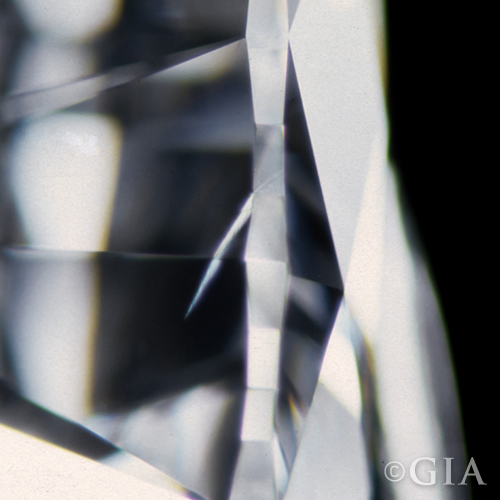
General trade term for a break in a gemstone, often white and feathery in appearance.
Courtesy of GIA
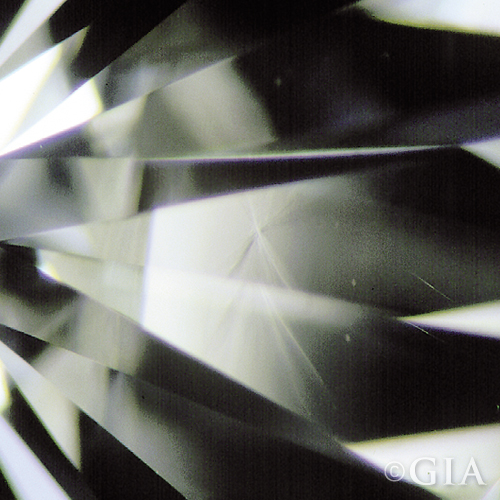
A small, concentrated area of crystal distortion; can be white or dark, and might have a thread-like or pinpoint-like appearance.
Courtesy of GIA
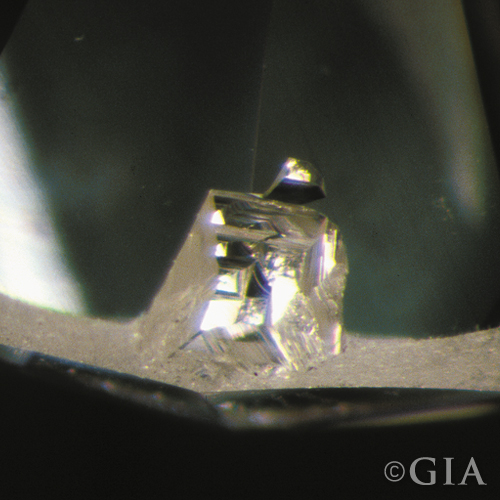
A portion of the rough diamond’s original surface that dips below a polished diamond’s surface.
Courtesy of GIA
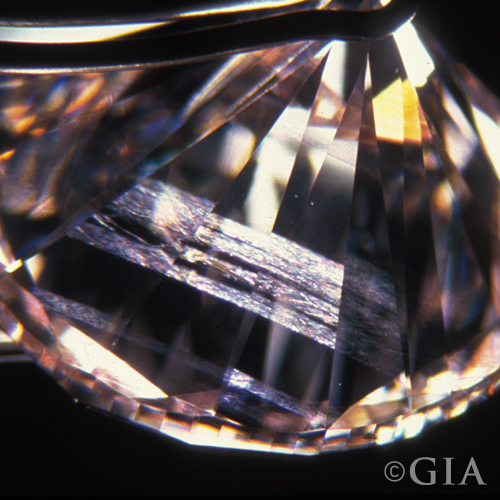
Lines, angles, or curves that might appear whitish, colored, or reflective, or affect transparency at 10X; caused by irregularities in crystal growth.
Courtesy of GIA
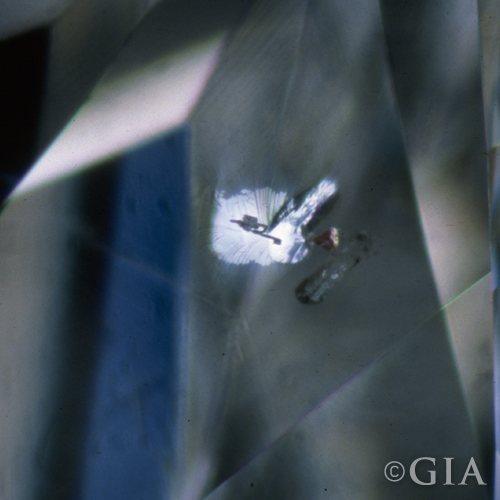
Laser drilling within a diamond that creates a surface-reaching feather, or expands a pre-existing feather around a dark inclusion so that it reaches the surface. The feather then provides access for bleaching to decrease the visibility of the inclusion.
Courtesy of GIA
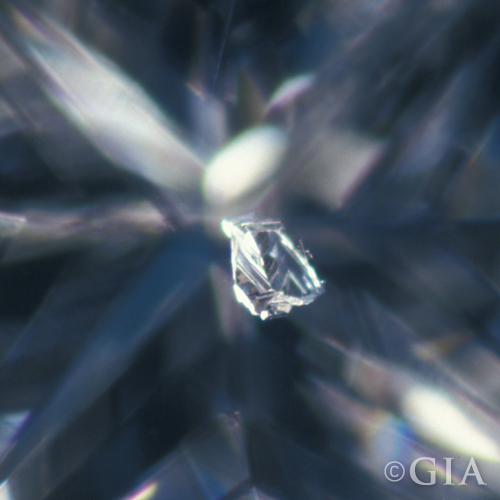
A white or transparent diamond crystal that extends to the surface after fashioning.
Courtesy of GIA
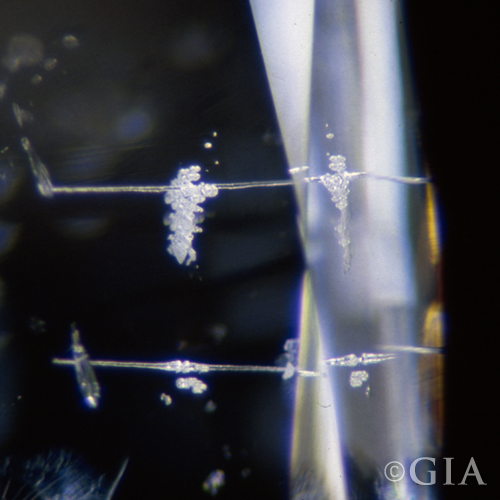
A tiny, surface-reaching tunnel produced by a laser light beam.
Courtesy of GIA
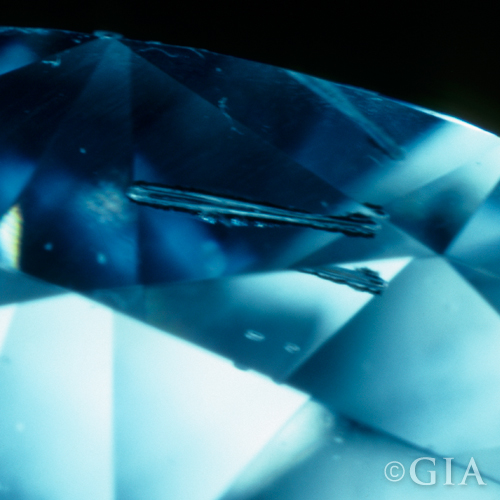
A thin, elongated crystal that looks like a tiny rod at 10x
Courtesy of GIA
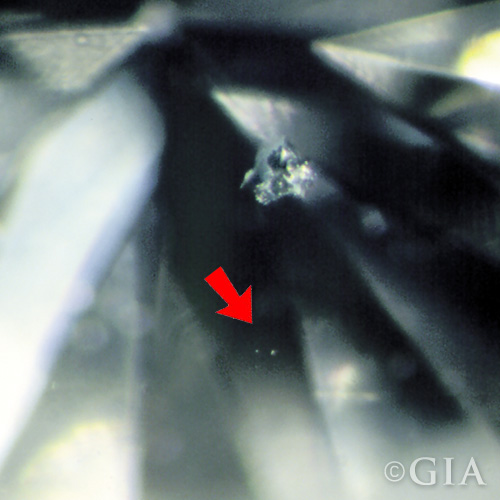
A very small crystal that looks like a tiny dot at 10X.
Courtesy of GIA
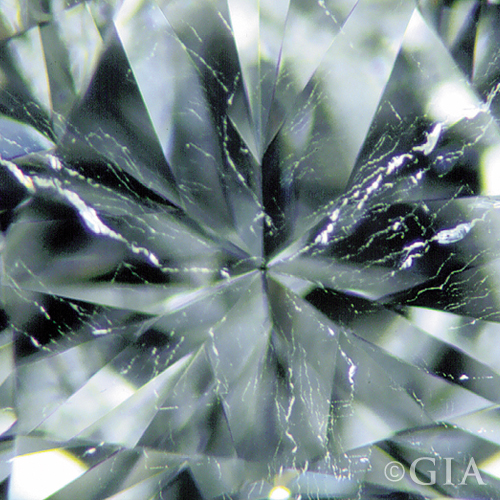
A series of pinpoints, clouds, or crystals that forms in a diamond’s growth place; associated with crystal distortion and twinning planes.
Courtesy of GIA
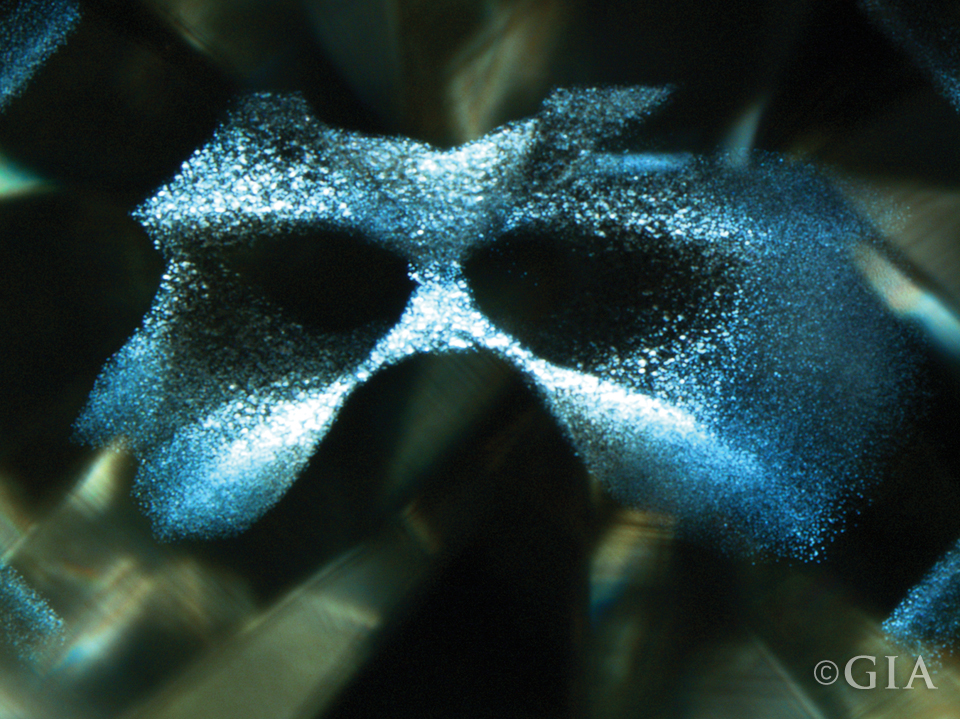
Featured here is a three-dimensional hydrogen cloud: a cloud is comprised of many tightly grouped pinpoint inclusions that might be too small to distinguish individually, but together have a hazy appearance. We see a festive outline of a Venetian Mask in this unique cloud inclusion.
Courtesy of John. I. Koivula/GIA
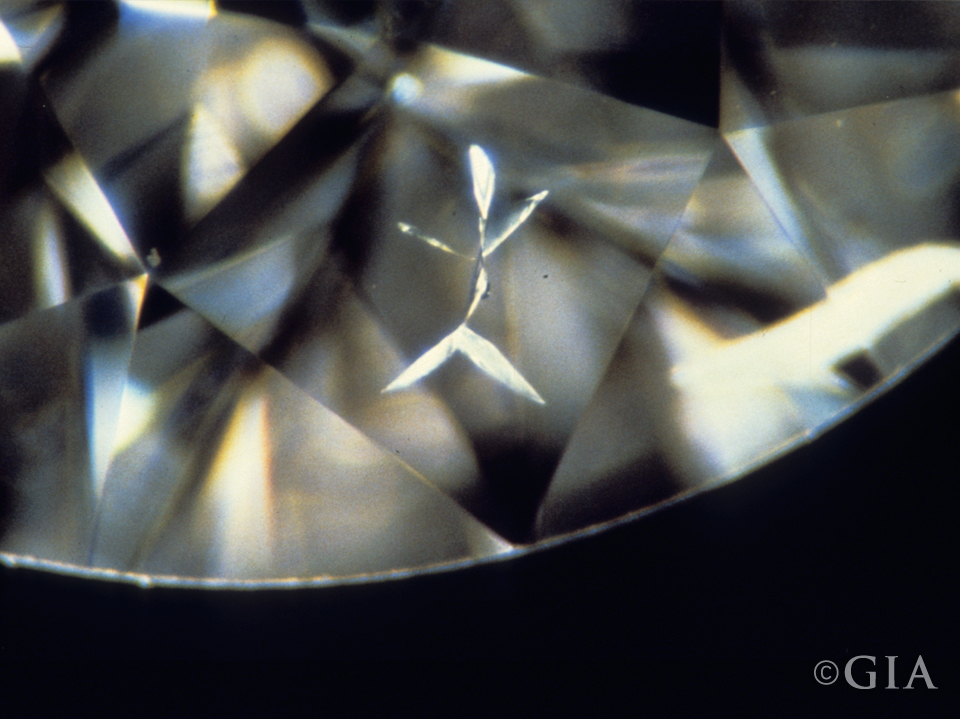
Some describe ballet dancers’ movements as light as a feather. In a diamond, a feather is a surface reaching break. This diamond’s feather inclusion appears to be a ballerina mid-arabesque — a lovely addition to a dancer’s or dance aficionado’s jewelry collection.
Courtesy of GIA
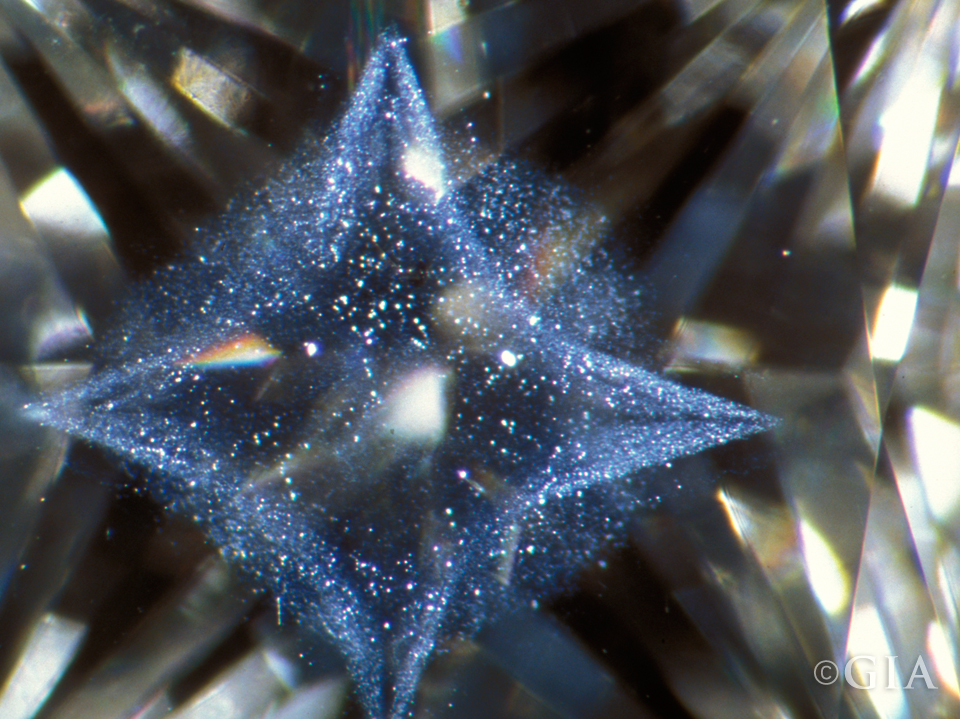
In general, the fewer inclusions within a diamond, the greater its desirability. With the use of fiber optic illumination, this stellate cloud becomes bright and beautiful with a stunning symmetrical design.
Courtesy of John. I. Koivula/GIA
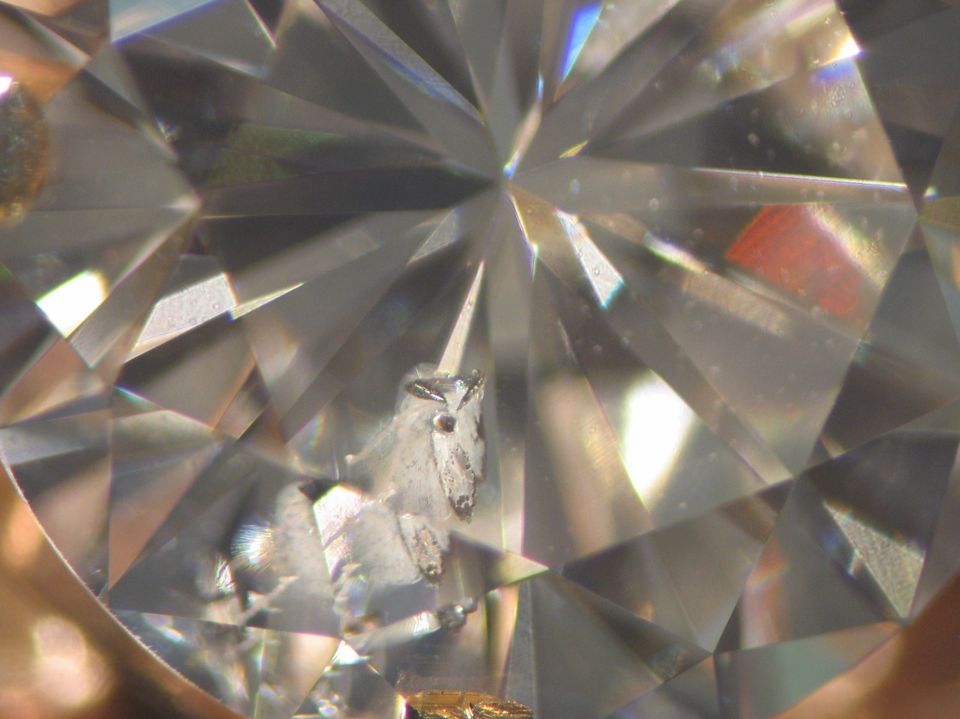
This unicorn-shaped inclusion consists of a white feather and some graphitization. Notice how the unicorn’s magical horn is perfectly placed with a white facet reflection above the feather.
Courtesy of Tim Schuler G.G
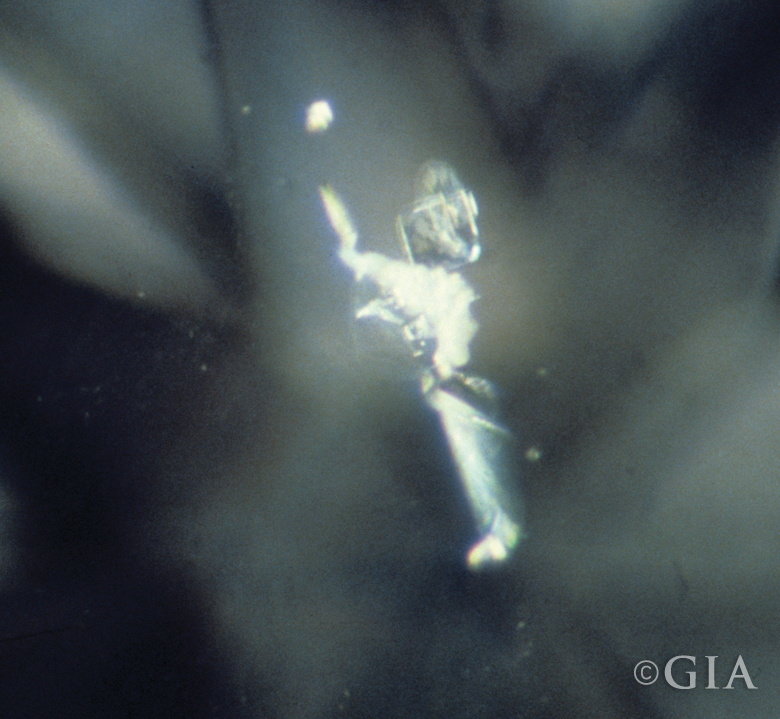
In this diamond, the inclusion is composed of a feather and crystal.
Courtesy of G. Robert Crowningshield
How Inclusions Affect Rough Diamond Valuation
- High-Inclusion Rough Diamonds: May be used for industrial purposes (drilling, cutting tools).
- Low-Inclusion Rough Diamonds: Have higher value and are prioritized for gem-quality cutting.
- Some Inclusions Indicate Origin: Certain inclusions (e.g., olivine) can suggest the diamond’s source, such as kimberlite or lamproite deposits.
Diamond Grading Reports
Diamond grading reports, or diamond certificates as they are often called, are documents prepared by independent, certified gemologists working in properly equipped laboratories, which describe the specific characteristics of a diamond. Typically, a diamond grading report gives a description of the diamond’s four C’s, as well as a plotted diagram of the stone and a description of its shape, including exact measurements, proportions and depth percentages.
It should also comment fluorescence and any imperfections in the diamond. A grading report does not include an appraisal of the value of the diamond. There are a large number of organizations and individuals offering grading reports.
GIA
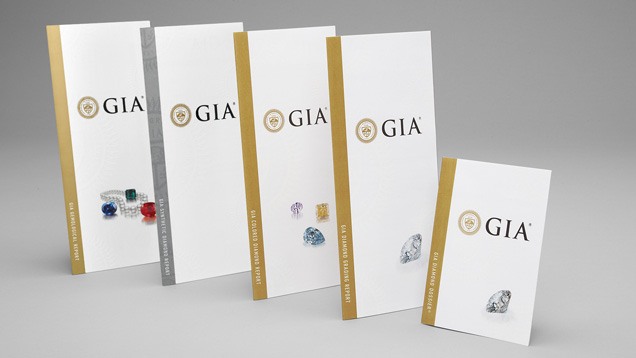
Established in 1931, GIA is the world’s foremost authority on diamonds, colored stones, and pearls. A public benefit, nonprofit institute, GIA is the leading source of knowledge, standards, and education in gems and jewelry.
EGL
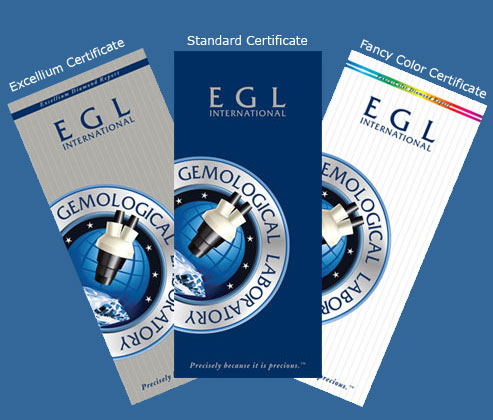
Started in 1973, Guy Margel opened the first European Gemological Laboratory in Antwerp. Today the EGL is the world largest independent network of gemological laboratories. EGL’s belief in professionalism and perfection has enabled it to become a dominating force in the world of gemological testing and education.
HRD Antwerp
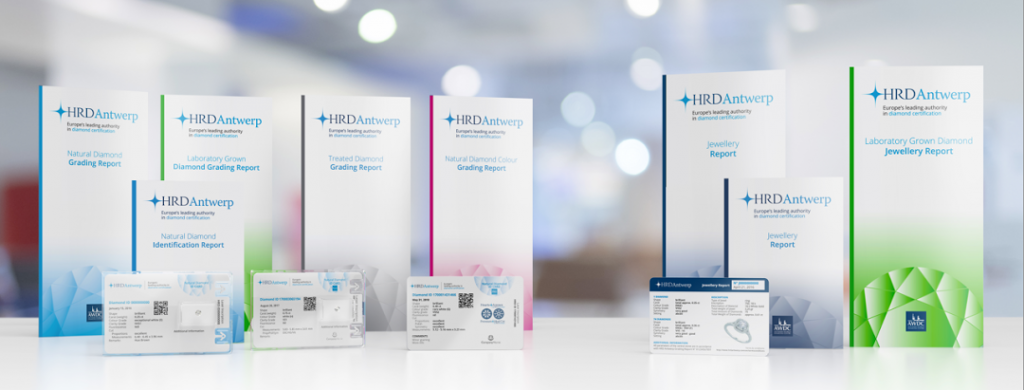
HRD Antwerp is Europe’s leading authority when it comes to diamond grading, education and equipment. We draw on 570 years of experience passed down through Antwerp’s diamond trade, and strive for perfection, delivering the highest quality in all our products and services.
The history of HRD Antwerp is intertwined with that of The Antwerp World Diamond Centre (AWDC). The latter is a private foundation, established in 1973 as the Hoge Raad voor Diamant (HRD) or Diamond High Council, at the initiative of the Belgian government and diamond industry representatives.
In 2007, the Diamond High Council was restructured and split into two different enterprises: AWDC and HRD Antwerp. As the official representative of the diamond community, the AWDC is committed to boosting business in the rough and polished diamond trade, as well as manufacturing, by organizing B2B initiatives. HRD Antwerp, on the other hand, became today’s leading authority in diamond certification.
Diamond Traceability in Rough Diamonds
What Is Diamond Traceability?
Diamond traceability refers to the ability to track a diamond’s journey from its origin (mine) to its final market destination. This ensures ethical sourcing, transparency, and compliance with regulations, helping to combat conflict diamonds and promote responsible mining practices.
Why Is Diamond Traceability Important?
- Ethical Sourcing – Prevents trade in conflict diamonds (blood diamonds) linked to human rights abuses.
- Regulatory Compliance – Meets industry standards like the Kimberley Process and OECD guidelines.
- Consumer Trust – Buyers, especially in luxury markets, prefer responsibly sourced diamonds.
- Sustainability – Encourages environmentally and socially responsible mining practices.
- Market Value – Fully traceable diamonds often command higher prices in ethical markets.
Methods of Diamond Traceability
1. Kimberley Process Certification Scheme (KPCS)
- What it does: Ensures rough diamonds are conflict-free before they enter the market.
- How it works:
- Each rough diamond shipment gets a Kimberley Process Certificate (KPC) that details its origin.
- The diamonds can only be traded between KPCS member countries (currently over 80).
- Limitations:
- Only regulates rough diamonds, not polished stones.
- Doesn’t always prevent smuggling or false certifications.
2. Blockchain Technology
- What it does: Creates a digital record of a diamond’s journey from mine to market.
- How it works:
- Each rough diamond is digitally registered at the source.
- Every transaction (from miner → trader → cutter → jeweler) is recorded in a tamper-proof blockchain ledger.
- Consumers can verify a diamond’s full history using a digital certificate.
- Examples:
- Tracr (by De Beers) – Tracks diamonds from mine to retail.
- Everledger – Uses blockchain + AI for supply chain transparency.
3. Diamond Fingerprinting & Scientific Analysis
- What it does: Uses the diamond’s unique characteristics to determine its geological origin.
- Methods:
- Spectroscopy (FTIR, Raman, Photoluminescence) – Identifies chemical signatures.
- Isotopic Analysis – Determines the carbon source.
- Inclusion Analysis – Certain minerals inside the diamond can reveal its country of origin.
- Benefits: Provides a natural way to trace a diamond without relying on paperwork.
4. Unique Identification & Laser Inscription
- What it does: Engraves a microscopic serial number or code on the diamond’s surface.
- Methods:
- GIA & IGI Laser Inscriptions – Used for tracking rough diamonds before cutting.
- QR Codes & Nano Inscriptions – Advanced techniques for deeper identification.
Challenges in Diamond Traceability
- Illicit Trade & Smuggling – Some diamonds enter the market illegally, bypassing the Kimberley Process.
- Mixing of Diamonds – Rough diamonds from different sources may get mixed during sorting.
- Fake Documentation – Some unethical traders forge certificates to mask a diamond’s true origin.
- Small-Scale Mining – Artisanal miners often don’t have access to formal tracking systems.
Future of Diamond Traceability
- AI & Machine Learning – Automating the tracking process through AI-powered databases.
- Universal Digital Passports – Industry leaders are working toward a global digital record for each diamond.
- Greater Consumer Awareness – More buyers are demanding traceable, ethically sourced diamonds.
PLEASE PROCEED TO THE QUIZ